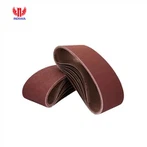
The grinding wheel is the main tool for grinding and is suitable for grinding high-hardness steel such as high-speed steel, high-carbon steel, hardened steel and alloy steel. It is a porous body composed of abrasive and bond. The abrasive, bond and structure are the three basic elements of the grinding wheel. According to the structure of the machine tool and the need of grinding, the grinding wheel is divided into a flat grinding wheel and a double concave grinding wheel. , double inclined grinding wheel, cylindrical grinding wheel, disc grinding wheel and bowl grinding wheel. So how to choose the hardness of grinding wheels such as white fused alumina and brown fused alumina (corundum)?
The hardness of the grinding wheel refers to the difficulty of the abrasive grains on the surface of the grinding wheel falling off under the action of the grinding force. The hardness of the grinding wheel is soft, which means that the abrasive grains of the grinding wheel are easy to fall off, and the hardness of the grinding wheel is hard, indicating that the abrasive grains of the grinding wheel are not easy to fall off. Wheel hardness and abrasive hardness are two different concepts. The same abrasive can be made into grinding wheels of different hardness, depending on the nature and amount of the bonding agent and the manufacturing process of the grinding wheel. The significant difference between grinding and cutting is that the grinding wheel has a "self-grinding" function. Choosing the hardness of the grinding wheel is actually choosing the self-grinding of the grinding wheel. It is hoped that the abrasive will not fall off or become dull.
The general principle for selecting the hardness of the grinding wheel is -- when processing soft metal, in order to prevent the abrasive from falling off prematurely, use a hard wheel. In the processing of hard metals, in order to make the blunt surface abrasive particles fall off in time, the new abrasive grains with sharp edges (ie, self-abrasive grains) are exposed, and a soft grinding wheel is selected. The former is because the abrasive work of the grinding wheel wears slowly and does not need to fall off prematurely; the latter is because the grinding abrasive wear speed of the grinding wheel is fast and needs to be updated quickly. In precision grinding, a slightly harder wheel should be used to ensure grinding accuracy and roughness. The workpiece material has poor thermal conductivity and is prone to burns and cracks (such as grinding carbide). The choice of grinding wheel should be soft.