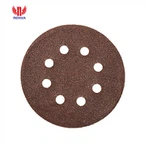
1, brown corundum, Brown fused alumina, Brown aluminium oxide:
The main chemical component, AL2O3, is made from bauxite, iron filings and anthracite in an electric arc furnace. The color of the brown fused alumina abrasive is brown, and in terms of its color, it is named brown fused alumina. This kind of abrasive has a certain hardness and toughness, has a strong grinding ability, and can withstand a lot of pressure. It has the characteristics of high temperature resistance, oxidation resistance, corrosion resistance and good chemical stability. Due to its high tensile strength, it is suitable for grinding materials with high tensile strength. It is suitable for ordinary steel, high carbon steel and alloy steel. It can be used for the processing of hard wood. It can also be used for the replacement of other abrasives. Abrasive is the most widely used abrasive in use.
2, white corundum, white fused alumina, white aluminium oxide:
The main chemical component is AL3O2, which is made by melting aluminum oxide powder in an electric arc furnace. The color is white, and it is named white corundum in terms of its color. The texture of white corundum is purer than brown corundum. The aluminum-oxygen powder raw material is prepared by pre-processing the bauxite used in brown corundum, and the main physical component is β-AL2O3 (no grinding ability), which is converted from β-AL2O3 to α-AL2O3 by electric arc furnace melting. The converted α-AL2O3 has a strong grinding force.
3. Black silicon carbide:
The main chemical composition is SiC. It is made of petroleum coke, quartz sand, wood chips and the like as raw materials in an electric resistance furnace. Black SiC has a black color and is named black silicon carbide in terms of its color. Black silicon carbide is more brittle than corundum, harder than hardness, and its toughness is second to that of corundum. For materials with low tensile strength, such as non-metallic materials (various plates such as wood plywood, particleboard, high-middle and low-density fiberboard). , bamboo board, calcium silicate board, leather, glass, ceramics, stone, etc.) and non-ferrous metals (aluminum, copper, lead, etc.) and other materials are particularly suitable for processing, and the processing of hard and brittle materials is also an ideal abrasive. .
4. Green silicon carbide:
The main chemical composition is SiC. The raw materials used in the manufacture are almost the same as those of black silicon carbide. The industrial salt is reacted as a reactant and accelerator in an electric resistance furnace. It is green in terms of its color, so it is named green silicon carbide. Green silicon carbide is more pure than black silicon carbide, and its hardness is higher than that of black silicon carbide. Its grinding application is the same as that of black silicon carbide. It is more suitable for fine grinding of materials such as grinding threads and grinding tools. A wider range of workpieces for cemented carbide and diamond products on grinding materials. Since the cost of manufacturing green silicon carbide is higher than that of black silicon carbide, such as the ratio of raw materials used, the addition of salt auxiliary materials, and the difference in power consumption and processing, etc., the price of green silicon carbide products is higher than that of products. Black silicon carbide is high. Therefore, in the comparison with black silicon carbide, the choice of green silicon carbide is generally not used in non-metallic and non-ferrous materials, but green silicon carbide is mainly used as hard alloy and precision grinding. Fewer belts and other coated abrasives use less green silicon carbide as the grinding material.
5, microcrystalline corundum:
The main chemical composition is AL2O3. The raw materials used are the same as those of brown corundum. Only the rapid cooling process is used in the smelting process to obtain the effect of fine crystallization. The finely crystallized corundum is mechanically stronger than ordinary corundum. Abrasives made of microcrystalline corundum are often used for hard-grinding materials such as coarse-milled cast steel and high-toughness titanium-nickel alloy steel, but are rarely used in the manufacture of coated abrasives.
6, Pink fused alumina, pink aluminium oxide:
It is the addition of a mixture of Cr2O3 in the production process of white corundum, which makes the corundum form a co-melt of white corundum and Cr2O3, changing the properties and structure of corundum. The toughness of chrome corundum is higher than that of white corundum, and its hardness is about the same as that of white corundum. The amount of Cr2O3 added is slightly different from that of the produced chrome corundum, and its color is also different. In the chrome corundum, the use of Cr2O3 is different, and its use is different. Therefore, in the abrasive such as chrome corundum Divided into several grades according to the different addition of Cr2O3. Chromium corundum-grinding materials are commonly used for precision grinding of sharpened steel, alloy steel and rebar sharpening and instrumentation parts. Chrome corundum is commonly used in the production of bonded abrasives and is rarely used in the manufacture of coated abrasives.
7, hollow ball abrasive:
The so-called hollow ball abrasive refers to an aggregate of spherical abrasives which is composed by uniformly coating the abrasive on the surface of a hollow sphere made of plastic 0.05-1 mm, and then the hollow ball abrasive prepared is as usual. A method of applying an abrasive tape to a surface of a substrate.
Hollow ball abrasives are generally employed when making fine grained products. Since the abrasive is very fine, if it is directly coated on the surface of the substrate, the abrasive layer is thin, the abrasive involved in grinding is less, the grinding efficiency is poor, and the abrasive is very fine, and the surface porosity of the abrasive belt is very low. It is easy to block. If a hollow ball abrasive is used, the surface of the belt will form a very "rough" grinding surface, and the surface porosity will be greatly increased. The surface of the belt will help to eliminate the obstruction of grinding, and more importantly, the surface of the belt will be involved in grinding. The number of abrasive grains will increase by several times or tens of times. The increase is determined by the ratio of the sphere diameter to the particle diameter. The larger the ratio, the larger the abrasive grains, which greatly improves the grinding efficiency and durability. Such as hollow ball abrasive belts are patented by Germany's HERMES company, which for the company is called "HERMESIT".
8. New ceramic abrasives with microcrystalline structure:
It is a sintered ceramic abrasive made by gel method. Its crystal size is about 1-3 microns. It is hard and tough. When grinding, the tiny crystals gradually fall off to reveal new crystals, which keeps the sharpness of the whole abrasive grain. American 3M Company in 1981 Put into the market in the year, named as the abrasive belt made by Cubutron, the grinding hammer is 71% higher than the zirconium corundum belt, and the efficiency of grinding nickel stainless steel is 150% higher than that of the zirconium corundum belt. The market also has SG abrasives from NORTON, USA. The SG abrasive belt is used to grind metal at a pressure of 400 PSI (the belt speed is 28 m/s). The amount of metal is 5 times higher than that of brown corundum; the CB ceramic belt named after Hermes of Germany. The abrasive belt made of this kind of abrasive is especially suitable for processing hard-to-grind materials under high-strength pressure, such as aerospace alloy, high-nickel alloy steel, vanadium-containing tool steel, and cobalt-containing alloy steel.
In addition, recently developed industrial countries have also developed coated abrasives made of synthetic diamond and cubic boron nitride (CNB) abrasives, specializing in the processing of hard alloys, quartz components and difficult-to-machine steels.
9, zirconium corundum abrasive:
It is a high toughness abrasive with ZrO2 and a 20 micron crystal size. ZrO2 is added in 40% and 25%. It is used for coating abrasives with sharper shapes. It is especially suitable for processing stainless steel parts and titanium alloy parts. In the Chinese market, Japan's NCA's zirconium corundum belt, NORTON's NORZON belt of the United States and South Korea's Korean grinding company's YZ533 and YZ633 zirconium corundum belts are more popular. According to the information provided by NOTON Company of the United States, the grinding efficiency is 254-300% higher than that of brown corundum. The processing of particleboard with NORZON abrasive belt increases the life of the belt by three times.
However, the zirconium corundum belt is not only used as a belt but also used in a large number of fixed abrasives.
10, composite abrasive:
It refers to the mechanical compounding of an abrasive with another abrasive rather than a chemical reaction. When the abrasive is manufactured, two kinds of abrasives are mechanically added to the molding material, and the various abrasives still maintain unique physical and chemical properties. When using it, take advantage of its strengths and achieve better results. For the purpose of grinding, synthetic abrasives are often used in foreign countries or in China to produce abrasive tools for difficult processing. This is the so-called clever name, another way to establish a brand. Common composite abrasives are compounded with brown fused alumina and white fused alumina, mixed with corundum and green silicon carbide, composited with brown fused alumina and black silicon carbide.
Composite abrasives are commonly found in bonded abrasives and are rarely used in the manufacture of coated abrasives.