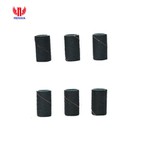
The segment and sharpening stones we often use can be divided into two types: natural whetstones and artificial whetstones.
In the market, there are mainly three common whetstones: terrazzo, honing stone and diamond.
Terrazzo and honing stone are natural whetstones.
Diamond and ceramic whetstones are artificial whetstones.
We know that before sharpening, the segment and sharpening stone must be lubricated with water and oil.
As the name suggests, water whetstone and oilstone are the segment and sharpening stones that need lubrication.
Some artificial whetstones can be used with lubrication or without lubrication, such as diamond and ceramic whetstones.
But there is one thing in common between artificial whetstones and natural whetstones.
That is, they all have different mesh counts, which is what we usually call coarse grinding and fine grinding.
However, it should be noted that different steels and hardnesses require different coarse and fine grinding stones for grinding, and sometimes even different grinding stone materials are required for grinding.
1. Honing Stone
Honing stone is a traditional whetstone. Although water-based whetstone is becoming more and more popular, oilstone is still the most common whetstone on the market.
Why is it called honing stone?
Because before using this type of segment and sharpening stone, you need to apply a little oil to it.
The benefits of applying a little oil are:
(1) It can reduce friction.
(2) It is also easier to move back and forth when grinding.
(3) Metal chips during grinding will remain in the oil, making it easier to wipe off after grinding.
However, honing stone is the slowest of the types of segment and sharpening stones we mentioned.
2. Terrazzo
Terrazzo is also an increasingly popular type of segment and sharpening stone. It must be soaked in water for a few minutes before use.
Just like oiling an oilstone, soaking the stone acts as a lubricant.
(1) It helps reduce friction when sharpening.
(2) It is also easier to move back and forth while sharpening.
(3) Metal debris from the grinding process will remain in the water, making it easier to wipe off the knife after sharpening.
Because natural whetstones are not as abundant as before and their prices are getting higher and higher,
synthetic oilstones and terrazzo are now available.
Synthetic whetstones are generally made of aluminum oxide.
Some synthetic whetstones need to be soaked before use, while others only require two drops of water.
Advantages of synthetic terrazzo
(1) It sharpens quickly.
(2) It is easier to clean with water as a lubricant than with oil.
However, artificial terrazzo also has a disadvantage: the whetstone wears out faster.
3. Ceramic Whetstone
Ceramic whetstones are an early substitute for natural whetstones.
However, the quality of ceramic whetstones varies greatly, so you should pay special attention when purchasing.
Like terrazzo and oilstone, ceramic whetstones should also be soaked before use.
Ceramic whetstones should be soaked for at least ten minutes or more to saturate the pores of the segment and sharpening stone.
4. Diamond
The name diamond is a bit confusing, making people think it is a very hard stone.
In fact, diamond is not a stone, but a very thin metal plate, a material made of some carbon raw materials and metal, with a layer of diamond attached to its surface.
Although it is not a stone, it is very hard, much harder than other types of segment and sharpening stones, as its name suggests.
So some novices may not be able to master it well and leave scratches on the blade.
The main advantage of diamond is that it can sharpen knives very quickly.
The second is its shape. Segment and sharpening stones are generally flat.
In the process of continuous use, the shape of natural whetstones will change from the original flat shape to curved, or concave in the middle.
Diamonds are easier to maintain their original flat shape during use.