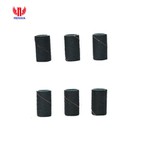
Selection of internal grinding wheel shape
The common shapes of internal grinding wheels are flat and cup (see the figure below). Flat grinding wheels are the most commonly used, and cup grinding wheels are more advantageous for grinding step holes and cross-sections.

The selection of internal grinding wheel can refer to the following table:
|
Processing materials |
Grinding requirements |
Characteristics of grinding wheels |
|||
|
Abrasive grit |
Grain size |
Hardness |
Binder |
||
|
Unhardened carbon steel |
Coarse grinding Fine grinding |
A A |
24-46 46-60 |
M K-N |
V V |
|
Aluminum |
Coarse grinding Fine grinding |
C C |
36 60 |
K-L L |
V V |
|
Cast iron |
Coarse grinding Fine grinding |
C C |
24-36 46-60 |
K-L K-L |
V V |
|
Pure copper |
Coarse grinding Fine grinding |
A A |
16-24 24 |
K-L K-M |
V V |
|
Hard bronze |
Coarse grinding Fine grinding |
A A |
16-24 24 |
J-K K-M |
V V |
|
Modulated alloy steel |
Coarse grinding Fine grinding |
A WA |
46 60-80 |
K-L K-L |
V V |
|
Hardened carbon steel and alloy steel |
Coarse grinding Fine grinding |
WA PA |
46 60-80 |
K-L K-L |
V V |
|
Nitriding steel |
Coarse grinding Fine grinding |
WA SA |
46 60-80 |
K-L K-L |
V V |
|
High speed steel |
Coarse grinding Fine grinding |
WA PA |
36 24-36 |
K-L M-N |
V B |
|
Binder |
Parallel grinding wheel |
||||
|
Outer diameter |
width |
Inner diameter |
|||
|
V |
20 |
6, 10, 20,25, 32 |
6 |
||
|
25 |
6,13,16,25 |
||||
|
25,32,50 |
10 |
||||
|
30 |
6,10,25,32,40,63 |
||||
|
35 |
6,8,10,25,32,40,63 |
||||
|
40 |
6,16,32 |
||||
|
6,10 |
13 |
||||
|
8,10,25,32,40,50,63 |
16 |
||||
|
45 |
32 |
||||
|
50 |
6 |
13 |
|||
|
6,8,10,16,20,25,32,40,50 |
16 |
||||
|
60 |
32,50 |
||||
|
8,10,16,20,25,32,40,50 |
20 |
||||
|
70 |
6,8,10,16,20,25,32,40,50 |
20 |
|||
|
80 |
8,10,16,20,25,32,50,63 |
||||
|
B |
20 |
||||
Grinding wheel installation
The internal grinding wheel is usually installed at one end of the grinding wheel connecting the long shaft. Some internal grinding wheels are directly installed on the internal grinding head spindle. There are two fastening methods: thread fastening and bonding fastening.
(1) Thread fastening is shown in the figure below. Since the thread has a large clamping force, the grinding wheel is installed more firmly.

The following matters should be noted when threading and fastening the grinding wheel:
1) The clearance between the inner hole of the grinding wheel and the extension shaft should be appropriate and should not exceed 0.2mm. If the clearance is too large, a piece of paper can be inserted between the inner hole of the grinding wheel and the extension shaft to prevent vibration or loosening during operation due to eccentric installation.
2) The two end faces of the grinding wheel must be padded with soft pads such as yellow paper, with a pad thickness of 0.2~0.3mm. The purpose is to make the grinding wheel evenly stressed and reliably fastened.
3) The end face of the extension shaft of the pressure-bearing grinding wheel should be flat, and the contact surface should not be too small, otherwise the friction area will be reduced and the grinding wheel cannot be reliably fastened.
4) The pressure-bearing end face of the fastening screw should be perpendicular to the thread to ensure that the grinding wheel is evenly stressed.
5) The spiral direction of the fastening screw is opposite to the direction of rotation of the grinding wheel, which can ensure that the grinding wheel will not loosen.
(2) Use adhesive to fasten the grinding wheel. As shown in the figure below, it is very difficult to fasten the grinding wheel for grinding small holes below φ15mm using screws, so bonding is used.

Commonly used adhesives are made from phosphoric acid solution (H3PO4) and copper oxide (CuO) powder.
When bonding and tightening, the following points should be noted:
1) When mixing, the copper oxide powder must be placed in a porcelain container, and the phosphoric acid solution must be gradually injected, while stirring continuously. The mixture must be evenly mixed and the concentration must be appropriate.
2) The adhesive should fill the gap between the grinding wheel and the extended shaft, and there should be no voids inside.
3) When drying in an electric furnace, the time should not be too long, so as to avoid the rapid expansion of the volume when the copper phosphate solidifies quickly, and even the cracking of the grinding wheel. The color of the adhesive can be observed. When it is dark green, the heating should be stopped immediately.