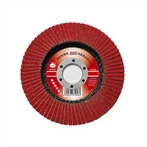
When purchasing a torque sanding disc, you may find that products with the same size and the same number of discs can vary in price by several times. Where does the difference come from?
It is not simply a matter of brand pricing. In many cases, the main difference comes down to the abrasive grain.
Stainless steel welds, carbon steel deburring, aluminum edge finishing, carbide die dressing, stone, glass, and other materials all have different abrasive requirements. Choose the wrong grain and you may struggle to remove material, remove too much, load the abrasive, or generate excessive heat and burn the workpiece.
Let's first break down the most common abrasive types used in torque sanding discs:
| Abrasive | Key Characteristics | Best Suited For |
|---|---|---|
| Aluminum Oxide | Versatile, cost-effective, moderate cutting action | Carbon steel, wood, and general-purpose metals |
| Ceramic Aluminum Oxide Blend | Ceramic and aluminum oxide blend, offering better cutting performance and service life than standard aluminum oxide; suitable for dry or wet grinding under moderate pressure | Stainless steel, alloy steel, and medium-pressure stock removal |
| Zirconia Alumina | Eutectic alumina-zirconia abrasive with good thermal stability, high fracture toughness, and strong self-sharpening performance | Continuous grinding of difficult-to-machine materials such as stainless steel and titanium alloys |
| Precision-Shaped Ceramic | Precisely formed triangular abrasive grains with self-sharpening action, cool cutting, fast stock removal, and long service life | Heavy stock removal and difficult-to-grind metals |
| Diamond | Micron-sized diamond particles secured in a metal coating with an open pattern to reduce loading | Stone, glass, ceramics, carbide, and composite materials |
One of the easiest mistakes to make is assuming that more expensive means better. Diamond abrasives are excellent for hard, brittle materials, but using them on mild steel or weld removal can be unnecessary and uneconomical. The higher price does not necessarily mean faster grinding.
On the other hand, standard aluminum oxide is affordable and versatile, but when used on difficult-to-grind stainless steel, it can dull more quickly, generate more heat, and lose cutting efficiency.
Selection Recommendations
1. Carbon steel and general-purpose metals, with cost as a priority → Aluminum oxide
A practical choice for routine grinding where balanced performance and cost are important.
2. Stainless steel and alloy steel, medium-pressure stock removal → Ceramic aluminum oxide blend
Suitable for both dry and wet grinding while balancing cutting performance and abrasive life.
3. Heavy stock removal and difficult-to-grind metals → Precision-shaped ceramic
A good option when the process demands fast cutting combined with extended abrasive life.
4. Continuous high-temperature grinding of stainless steel and titanium alloys → Zirconia alumina
Its thermal stability and self-sharpening characteristics make it suitable for demanding continuous grinding.
5. Stone, glass, ceramics, carbide, and composites → Diamond
These hard and brittle materials are where diamond abrasives are particularly well suited.
3 Questions Buyers and Manufacturers Often Ask
Q: Why should I choose this abrasive?
Match the abrasive to the workpiece material and required stock removal instead of choosing solely by price. The right grain can have a much greater effect on actual grinding costs.
Q: When is a particular abrasive not suitable?
Diamond is generally not a cost-effective choice for mild steel, while standard aluminum oxide may provide low efficiency and excessive loading when grinding difficult stainless steel. The same principle applies when selecting a torque sanding disc: abrasive selection should follow the material and grinding conditions.
Q: How can I tell whether a product is actually cost-effective?
Look at disc life × material removal rate per unit time, rather than focusing only on the price of one disc. A higher-priced abrasive may deliver a lower overall grinding cost if it removes material faster and lasts longer. This is also an important consideration when evaluating a torque sanding disc for production use.
There is no single abrasive that is always better for every application. The right choice depends on the workpiece, grinding operation, stock removal, applied pressure, and dry or wet working conditions. When selecting a torque sanding disc, consider these factors together rather than looking at the abrasive price alone.