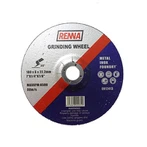
The purpose of steel ball hard grinding is to remove surface defects in the previous process and the decarburization, oxide layer and surface troostite structure produced during heat treatment, further improve the dimensional accuracy, spherical accuracy and surface quality, and prepare for the subsequent grinding process. Hard grinding is a grinding method that uses a cast iron disc as a fixed disc and a grinding wheel as an abrasive tool to process the surface of the steel ball, as shown in Figure 1.

During the hard grinding process, the steel ball is guided by the annular groove on the working surface of the fixed plate, and the steel ball is pressed against the working surface of the grinding wheel, and the steel ball is ground under the action of pressure. After the steel ball continuously rolls the working surface of the grinding wheel, grooves will gradually form on the working surface. During the grinding process of the steel ball, since the linear velocity at the outer edge of the grinding wheel groove is greater than the linear velocity at the inner edge of the grinding wheel groove, during the operation of the grinding wheel, sliding friction will inevitably occur at the contact position between the grinding wheel and the steel ball; as the groove depth increases as the friction increases, the sliding friction effect also increases; the sliding friction at the bottom edge of the grinding wheel groove is small, but the rolling effect is the largest; under this complex friction, the abrasive grains on the surface of the grinding wheel groove affect the steel The ball acts as a grinder. The motion state of the steel ball during the grinding process is also complex, including the revolution of the steel ball around the axis of the grinding wheel and the rotation of the steel ball around its own center. The rotation can continuously change the direction, so that any point on the surface of the steel ball has the opportunity to be grinded; the revolution cooperates with the cyclic grinding method of the machine tool to finally realize the hard grinding process of the steel ball.
The grinding wheel is an important tool in the steel ball hard grinding process. Combined with the characteristics of hard grinding, in order to better ensure the accuracy and surface quality of the steel ball, the following selection principles should be followed for the vitrified grinding wheel for steel ball hard grinding:
1. Grinding wheel specifications and dimensions
The main specifications and dimensions of the grinding wheel include: outer diameter, hole diameter and thickness, which can be reasonably selected based on the technical performance of the machine tool. The common dimensions and specifications of ceramic grinding wheels for steel ball hard grinding are shown in Table 1.
|
Serial Number |
Outer Diameter(mm) |
Thickness(mm) |
Hole(mm) |
|
1 |
720 |
80 |
290 |
|
2 |
800 |
100 |
290 |
|
3 |
800 |
100 |
360 |
|
4 |
800 |
100 |
420 |
|
5 |
800 |
100 |
450 |
|
6 |
800 |
140 |
420 |
|
7 |
900 |
100 |
360 |
|
8 |
1000 |
100 |
360 |
Table 1 Common dimensions and specifications of vitrified grinding wheels for steel ball hard grinding
2. Types of abrasives
Abrasives are an important part of abrasive tools and mainly play a grinding role. The choice of abrasive type when designing abrasive tools mainly depends on the material of the grinding object. Bearing steel balls are mostly made of bearing steel, and corundum-based abrasives can be preferred. Brown corundum has strong resistance to crushing and high toughness, and is most commonly used in the production of steel ball hard grinding ceramic grinding wheels. During the grinding process, when the abrasive grains are passivated, due to the relatively high toughness of the corundum abrasives, the abrasive grains cannot break by themselves under the grinding action to expose new edges, which in turn affects the grinding efficiency. Therefore, the steel ball heat treatment process and the grinding process are combined. To improve the cutting characteristics, you can choose to introduce silicon carbide abrasives appropriately, that is, the vitrified grinding wheel for steel ball hard grinding uses a mixed abrasive of corundum and silicon carbide.
3. Abrasive particle size
When selecting abrasive particle size, it is mainly based on the grinding surface roughness requirements and grinding efficiency. First of all, it is necessary to ensure that the surface roughness of the workpiece after grinding meets the requirements. If the particle size is too coarse, the coarse-grained abrasive will cut a large amount during grinding and generate more heat, but the heated area will be small, and small spots will easily appear on the surface of the steel ball. If the particle size is too fine, it will affect the grinding efficiency on the one hand, and on the other hand, due to the small cutting force of the fine particle size, the steel ball and the groove arc surface mostly exist in the form of friction, which generates a large amount of friction heat, and the surface of the steel ball Burns may occur easily. On the basis of meeting the requirements of machining surface roughness, try to use coarse-grained abrasives to improve the grinding efficiency of the grinding tool. For the particle size selection of ceramic grinding wheels for steel ball hard grinding, please refer to Table 2.
|
Serial Number |
Steel Ball Category |
Grinding Wheel Size |
|
1 |
Microspheres |
F280-F320 |
|
2 |
Small Ball |
F180-F240 |
|
3 |
Hit The Ball |
F150-F180 |
|
4 |
Big Ball |
F120-F150 |
Table 2 Grain size of vitrified grinding wheels for hard grinding with different steel balls
4. Grinding wheel hardness
Hardness is one of the important indicators to measure the quality of grinding wheels. For ceramic grinding wheels used for steel ball hard grinding, if the hardness is too soft, the abrasives will fall off prematurely during the grinding process, exposing new abrasive grains. These new abrasive grains have greater Sharp grinding blade has strong grinding ability and generates a large amount of heat. If the cooling is not timely, it will cause spot burns on the surface of the steel ball. At the same time, because the hardness of the grinding wheel is too soft, the groove will be reduced during the grinding process. The restraint of the steel ball on the groove surface can easily cause excessive changes in the diameter of the steel ball. If the hardness is too high and the self-sharpening property is poor, as the groove arc surface continues to grind the steel ball diameter, the diameter of the steel ball becomes smaller and the groove arc surface and the steel ball surface have poor conformity, reducing the groove's impact on the steel ball. The binding force can easily cause the steel balls to roll together, and in severe cases, linear burns will appear on the surface of the steel balls.
The hardness grade of the vitrified grinding wheel used for hard grinding of steel balls is grade Y. The depth of the sand blasting hardness pit in the 28cm3 sand chamber of the ceramic grinding wheel for grinding steel balls is not greater than 0.6mm. The hardness of the grinding wheel is carried out in accordance with the regulations. Three sandblasting hardness tests are performed at each point, and the third test value is the final hardness value. For the hardness selection of ceramic grinding wheels for steel ball hard grinding, please refer to Table 3.
|
Serial Number |
Steel Ball Category |
Sandblasting Hardness Pit Depth(mm) |
|
1 |
Microspheres |
≤0.45 |
|
2 |
Small Ball |
≤0.5 |
|
3 |
Hit The Ball |
≤0.55 |
|
4 |
Big Ball |
≤0.6 |
Table 3 Hardness of vitrified grinding wheels for hard grinding without steel balls
In summary, the various characteristics of the grinding wheel have an important relationship with the grinding quality, and they need to be selected carefully.