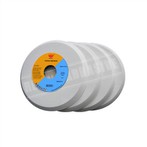
1. The diameter of the internal grinding wheel should not be too large or too small
When grinding the inner hole, if the diameter of the grinding wheel is too large, the contact arc between the grinding wheel and the workpiece will increase, which will increase the grinding heat and make cooling and chip removal difficult. If the diameter of the grinding wheel is too small, it is difficult to achieve the ideal grinding speed (30m/s~50m/s), which will increase the grinding thickness, increase the stress on the abrasive particles, and easily blunt the surface, increase the roughness of the inner hole, and reduce production efficiency.
In order to obtain a good grinding effect, the grinding wheel diameter should maintain an appropriate ratio to the inner hole diameter, which is usually between 0.5 and 0.9. When the aperture is small, the problem is that the circumferential speed of the grinding wheel is low, and a large ratio should be taken at this time; when the hole spacing is small, the main problem is that cooling and chip removal are difficult, and a smaller ratio should be taken at this time.
2. The width of the internal grinding wheel should not be too wide or too narrow
When grinding the inner circle, if the width of the grinding wheel is too narrow, the grinding wheel is easy to wear, which is not conducive to improving production efficiency and reducing surface roughness; if the grinding wheel is too wide, the grinding force increases, which is easy to cause the grinding wheel to bend and deform. Therefore, when grinding the inner hole, the appropriate grinding wheel width should be selected.
3. The selection details of CNC internal grinding wheel are more important
The quality of grinding of CNC internal grinding machine also depends on the grinding wheel to a large extent. Grinding wheel plays a key role in the grinding quality of CNC grinding machine. We often use electroplated grinding wheel, resin grinding wheel, ceramic grinding wheel, CBN grinding wheel, etc., so what kind of grinding wheel should we choose to be most suitable for us?

Ⅰ. Selection of internal grinding wheel shape for CNC grinders
The commonly used grinding wheel shapes for CNC grinders are cylindrical and cup-shaped. Cylindrical grinding wheels are mainly used to grind through holes, while cup-shaped grinding wheels are mainly used to grind the outside of inner holes and can also grind the end faces of step holes.
Ⅱ. Selection of internal grinding wheel diameter for CNC grinders
In order to achieve the ideal grinding speed during the grinding process, it is generally best to use a grinding wheel close to the aperture. However, when the grinding wheel diameter increases, the contact arc between the grinding wheel and the workpiece also increases, resulting in increased grinding heat, making chip removal and cooling more difficult. In order to achieve better results, there is generally an appropriate ratio between the grinding wheel diameter and the aperture of the workpiece being ground, usually between 0.5-0.9.
Ⅲ. Selection of internal grinding wheel width
The use of wider grinding wheels in CNC grinding machines is beneficial to reducing the surface roughness of the workpiece and improving production efficiency, and can reduce the wear of the grinding wheel. However, the grinding wheel cannot be too wide, which will increase the grinding force and cause bending deformation of the grinding wheel connecting shaft. The grinding wheel width can be selected according to the length of the workpiece within the rigidity of the grinding wheel connecting shaft and the allowable range of machine tool power.
Ⅳ. Selection of abrasive, particle size, hardness and binder
The characteristics of the grinding wheel of CNC internal cylindrical grinder. The selection of abrasive, particle size, hardness and binder can be based on the material and processing accuracy of the workpiece. Generally, the grinding wheel used in CNC internal cylindrical grinder should be 1-2 looser than the external cylindrical grinding wheel.