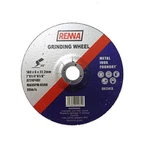
Let's start with the advantages of resinoid grinding wheels:
First, high bond strength.
Compared with other bonding agents, resin has higher bond strength and can be used at higher speeds while withstanding greater grinding pressure. Therefore, it is widely used for deburring, cleaning, and rough grinding in the steel and foundry industries. As grinding technology has developed, the requirements for grinding load and wheel strength have also increased. Grinding equipment has evolved from handheld and suspended grinders to today's high-speed, heavy-duty billet grinding machines. Resinoid grinding wheels operating speeds have increased from 35–40 m/s to 80–100 m/s, while grinding loads have risen from 30–50 kg to more than 1,000 kg. Without a high-strength bond, these demanding applications would be difficult to achieve.
Second, special shapes and customized designs can be produced.
This is mainly because resin bonds cure at relatively low temperatures, generally below 200°C, without changing the basic properties of the abrasive material. Fillers or reinforcing materials can therefore be added according to different requirements. For example, wheels can be manufactured with grooves or porous structures to meet specific grinding needs. Glass fiber mesh and other metal wires can also be embedded in the wheel to increase strength. Copper powder, aluminum powder, and graphite powder can be added to improve electrical conductivity.
Third, they are suitable for manufacturing thin wheels in various specifications.
Thin wheels are widely used for cutting and slotting operations in many metalworking applications. The thinnest wheels can reach approximately 0.1 mm, allowing them to perform operations that conventional saw blades cannot easily accomplish. With the increasing use of high-speed reinforced wheels, the demand for cutting wheels has also grown rapidly.
Fourth, resin bonds provide a certain degree of elasticity.
During grinding, this elasticity helps achieve the surface finish requirements of the workpiece. In machining, resin-bonded wheels are commonly selected for fine grinding and polishing. Under the same grinding conditions, resinoid grinding wheels can generally produce a finer surface finish than vitrified grinding wheels.
However, resinoid grinding wheels also have some disadvantages:
First, relatively poor heat resistance.
This can affect the service life of the wheel. Therefore, under the same grinding conditions, a resin-bonded wheel is generally selected at a slightly harder grade than a vitrified wheel.
Second, poor resistance to alkaline environments.
When stored in alkaline solutions for extended periods, the resin can deteriorate, causing its bond strength and hardness to gradually decrease. Therefore, when using resinoid grinding wheels, alkaline, especially strongly alkaline, coolants should be avoided whenever possible.
Third, limited water resistance.
Prolonged exposure to moisture can reduce the bonding performance of the resin. For this reason, resinoid grinding wheels should not be stored for excessively long periods. If they have been stored for more than one year, they should be inspected again before use.