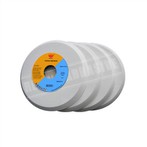
Black silicon carbide is a synthetic abrasive produced by high-temperature smelting of quartz sand, petroleum coke or coal coke, and wood chips in a resistance furnace. While it exists in nature, industrial use mainly depends on artificial production to ensure consistent quality. In pure form, it is colorless and transparent, but impurities make it appear black in practice.
Production Process and Structure
After smelting, black silicon carbide is obtained in blocks and must be processed through crushing, acid-base washing, magnetic separation, and screening or water classification to achieve uniform particle sizes. It has a hexagonal crystal structure, with a microhardness of 2840–3320 kg/mm² and a specific gravity of 3.20–3.25, giving it excellent wear resistance and strength.
Performance Characteristics and Material Types
The SiC content of black silicon carbide is about 98.5%, offering better toughness than green silicon carbide. It is suitable for processing low tensile strength materials such as glass, ceramics, stone, refractory materials, cast iron, and non-ferrous metals. A higher-purity type (over 99% SiC) provides strong self-sharpening ability and is widely used in precision machining, including hard alloys, titanium alloys, optical glass, and high-speed steel tools. A special cubic variant is designed for ultra-fine applications like bearing finishing, significantly improving surface roughness.
Application Scope of Black Silicon Carbide
With stable chemical properties, high thermal conductivity, low expansion coefficient, and strong wear resistance, black silicon carbide is widely used in abrasives such as grinding wheels and coated tools for efficient grinding and polishing. It can also be applied as a wear-resistant coating to extend the service life of components like turbine parts and cylinder walls.
In addition, it is used in refractory materials due to its high-temperature resistance. Lower-grade products serve as deoxidizers in steelmaking, improving efficiency and quality. Its semiconductor properties also make it suitable for heating elements and electronic components, highlighting the broad industrial value of black silicon carbide.