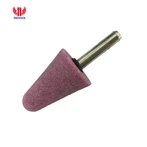
In precision grinding, the vitrified bond grinding wheel is widely recognized as the industry standard. From bearing raceway grinding and turbine blade root machining to hydraulic valve finishing and medical implant surface treatment, it is used wherever high accuracy and consistent surface quality are required. The reason lies in its unique bonding structure and performance.
The Nature of the Vitrified Bond: A Glass-Phase Network Structure
The main component of a vitrified bond is silicate glass. During high-temperature firing, it forms a continuous glass-phase network between abrasive grains. Similar to glass manufacturing, different oxides melt and react to create strong bonding bridges. Unlike resin bonds, which rely mainly on physical adhesion, a vitrified bond grinding wheel may also form chemical bonds with specially treated abrasive grains.
This structure provides high bond strength, excellent chemical stability, and superior heat resistance. A vitrified bond grinding wheel remains stable above 300°C, while resin bonds typically begin to soften at around 150°C.
Self-Sharpening: The Core Advantage
One of the biggest challenges in precision grinding is wheel dulling, which increases grinding forces and may burn the workpiece.
A vitrified bond grinding wheel naturally solves this problem through self-sharpening. As abrasive grains become dull, the bond fractures and exposes new sharp cutting edges. Compared with resin-bonded wheels, which often require frequent dressing, vitrified wheels maintain stable cutting performance for longer periods, delivering more consistent grinding forces and better surface quality.
Controlled Porosity: Balancing Chip Clearance and Wheel Life
A vitrified bond grinding wheel can be manufactured with controlled porosity. These pores provide space for chip removal while allowing coolant and air to circulate through the grinding zone, improving heat dissipation.
Different porosity levels suit different applications. Lower porosity provides higher strength for heavy-duty grinding, while higher porosity is ideal for precision grinding of thin-walled or heat-sensitive parts.
Rigid Bonding and Dimensional Stability
The high rigidity of a vitrified bond minimizes elastic deformation during grinding, allowing the vitrified bond grinding wheel to maintain excellent profile accuracy. This makes it particularly suitable for form and profile grinding.
Its high wear resistance and low thermal expansion also help maintain stable dimensions during long production runs, ensuring consistent machining accuracy.
A vitrified bond grinding wheel is widely used for bearing raceways, hydraulic components, gear teeth, cutting tools, and aerospace turbine blade machining. However, because vitrified bonds are relatively brittle, they are not suitable for heavy impact applications. Proper dressing methods and coolant selection should also be considered during use.
Selection Considerations
When selecting a vitrified bond grinding wheel, focus on the bond formulation, porosity, abrasive type, and grit size. These factors determine hardness, self-sharpening ability, chip clearance, grinding efficiency, and surface finish. Choosing the right combination for the application will help achieve the best machining results.