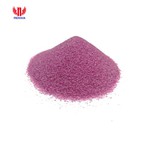
During the production of tabular alumina, color impurities have always been a significant factor affecting product quality and appearance. These impurities not only affect the aesthetics of the product but can also negatively impact its performance.
1. The impact of raw materials
The main raw material for tabular alumina is aluminum oxide, and its purity and chemical composition play a decisive role in the final product's color. First, if the aluminum oxide contains trace amounts of impurities such as MgO or CuO, these elements may react with the aluminum oxide at high temperatures, resulting in off-colors such as pale yellow or pale purple. Furthermore, if the iron-containing metal (such as Fe2O3) content in the raw material is too high, or if it is not effectively removed, it will leave black or gray impurities in the product.
Besides impurity content, the sulfur content in the raw material is also a key factor affecting the color of tabular alumina. Studies have shown that when the sulfur content in aluminum oxide is too high, during high-temperature calcination, sulfur ions penetrate the crystal lattice of aluminum oxide, affecting crystal growth and color. This effect is more significant when the crystal size is larger, easily leading to a yellowish color in the product.
2. The impact of production equipment and processes
The production process of tabular alumina involves several stages, including grinding, shaping, drying, and sintering. Improper operation of equipment or processes during these stages can introduce impurities, which can affect the final product's color.
⑴ Equipment Materials:
The storage bins and conveying equipment used in the production of tabular alumina typically consist of metal materials containing elements such as iron, titanium, nickel, and chromium. If the equipment maintenance procedures are not followed correctly, metal debris such as weld spatter or scraps of metal sheet may be mixed with the raw materials and enter the high-temperature vertical kiln. Under high temperatures, these metal impurities vaporize, producing metal vapors containing iron, titanium, nickel, and chromium, which then penetrate into the semi-molten sintered alumina spheres, causing the product to exhibit undesirable colors such as grayish-black, pink, or blue.
⑵ Atmosphere control:
The atmosphere within the kiln also significantly affects the color of the tabular alumina. Under a reducing atmosphere (high CO concentration), the presence of ferrous iron and titanium ions can cause it to appear blue or black; while under an oxidizing atmosphere, the presence of iron, chromium, and manganese ions can cause the tabular alumina to appear pinkish-red or even darker. Therefore, proper control of the atmosphere within the kiln is crucial for minimizing the occurrence of color variations.
⑶ Pelletizing technology:
Most production plants use rotary drum pelletizers for pelletizing, but the control of parameters such as rotation speed, water addition, and powder dosage during the pelletizing process is not precise enough, which can easily lead to layering during the process, thus affecting the color uniformity of the product. Furthermore, the drying method used for the pellets can also affect the product's color.
3. The impact of smelting processes
The duration of the smelting process and the maturity of the technology are also important factors affecting the color of tabular alumina. Insufficient smelting time or an immature process may lead to incomplete removal of impurities from the raw materials, or incomplete formation of alumina crystals, resulting in color variations in the final product. In particular, if the smelting temperature is not high enough or the holding time is too short, the growth of alumina crystals is restricted, making them more susceptible to the influence of impurity elements, which can cause color changes.
4. Solutions
To address the issue of color variations that occur during the production of tabular alumina, the following approaches can be taken:
⑴ Optimize raw material selection:
Use alumina with higher purity and lower impurity content as the raw material to reduce impurity contamination at the source. At the same time, strengthen the inspection and screening of raw materials to ensure that their quality meets production requirements.
⑵ Improve production equipment and processes:
Utilize more advanced production equipment and processes to enhance precision and stability. Strengthen equipment maintenance and repair work to ensure optimal operating conditions. Furthermore, optimize the atmosphere control system within the kiln and the pelletizing technology to improve the color uniformity and consistency of the product.
⑶ Strengthen production management:
Establish a sound production management system and quality control system to strictly monitor every stage of the production process. Enhance training and management of production staff to improve their professional skills and sense of responsibility. Furthermore, strengthen product quality testing to ensure that the products meet the required quality standards.
⑷ Develop new technologies:
Actively research and develop new technologies and processes to improve the production efficiency and product quality of tabular alumina. For example, explore more environmentally friendly and efficient calcination technologies to reduce energy consumption and pollution; develop new pelletizing and drying technologies to enhance product color uniformity and consistency, etc.
In summary, the occurrence of color variations during the production of tabular alumina is due to multiple factors, requiring comprehensive measures to address issues related to raw material selection, production equipment and processes, smelting technology, and production management. Only by strengthening quality control at every stage can we ensure that the quality and appearance of the tabular alumina meet the required standards.