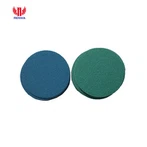
Sanding blocks, or sponge sanding bricks, are a type of abrasive tool. Compared to ordinary sandpaper, sanding blocks do not use paper or cloth as the abrasive carrier. Instead, the abrasive is embedded in a sponge or TPU. This is the main difference between sanding blocks and ordinary sandpaper. In addition, there are the following differences:
1. Regular sandpaper is commonly used for sanding rough, flat surfaces, while sponge blocks are better suited for grinding curved surfaces.
2. Regular sandpaper is generally in sheet form, while sponge blocks can be made into various shapes and sizes.
Regular sandpaper is typically used for dry sanding, while sponge blocks are absorbent and water-resistant, suitable for both dry and wet sanding.
With the invention and application of sanding blocks, they are being used in more and more situations. So, can sanding blocks replace sandpaper?
Like regular paper sandpaper, sponge block has a layer of abrasive on top of paper, while sponge block has a layer of abrasive on top of sponge or TPU. Sponge block can be considered an upgraded version of regular sandpaper. Relatively speaking, sponge block is more durable, softer, and absorbs water better than regular sandpaper. Moreover, because the sandpaper is made of sponge, it provides excellent pressure and even force during sanding. Although the sanding efficiency is similar to that of regular paper sandpaper, the sanding experience is better. Furthermore, sponge block of the same grit provides a more even sanding effect than regular sandpaper.
The biggest advantage of sanding blocks is that, with the same abrasive and grit size, the surface treatment effect is better than that of ordinary sandpaper. At coarser grits, the cutting ability and durability are also higher than those of traditional abrasive cloth and sandpaper.
Therefore, overall, sanding blocks are better than ordinary sandpaper and can be used in place of ordinary sandpaper. They are generally used in areas with high sanding requirements, such as hand sanding of furniture, polishing of plastic product surfaces, sanding of car repair and paint touch-up areas, and surface treatment of metal rust and plastics.