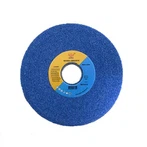
Calcined brown fused alumina abrasives differ from uncalcined fused alumina abrasives in toughness, strength, hydrophilicity, and grinding ability.
Advantages of calcining brown fused alumina abrasive:
1. Eliminates abnormal expansion of brown fused alumina abrasive.
During the smelting of molten corundum, the abrasive contains low-valent titanium oxide, titanium carbide, and titanium nitride. Calcination in an oxidizing atmosphere further oxidizes the abrasive, causing its volume to increase beyond its normal expansion, a phenomenon known as abnormal expansion.
This abnormal expansion leads to network cracks on the surface of brown fused alumina ceramic grinding wheels during firing, resulting in a large number of defective products. Calcination is an effective means of eliminating abnormal expansion in brown fused alumina abrasive.
2. It reduces the bulk density of the abrasive and improves its toughness.
During the calcination process, lattice shrinkage is caused by the oxidation of Ti3+ in the solid molten steel crystals, which increases the compressive strength of the abrasive. Secondly, calcination can also compensate for the internal stress generated during particle formation. Therefore, calcined abrasives are used to produce various durable and sharp abrasives with improved grinding performance, and are widely used in the production of resin discs and heavy-duty wheels.
3. Improve the hydrophilicity of brown fused alumina abrasive.
Calcining brown fused alumina abrasive at 800°C to 1350°C for 2-4 hours increases its hydrophilicity by 3.5 times. This is mainly because it removes volatiles and other impurities from the abrasive surface, burns off low-melting-point substances, and increases capillary action on the abrasive surface.
The abrasive bulk density decreases accordingly, hydrophilicity is improved, and the durability of the abrasive used for coating can be increased by approximately 30%.
Disadvantages of calcining brown fused alumina abrasive:
1. Deterioration of fluidity.
Due to the removal of impurities such as volatiles from the surface of calcined abrasives, low-melting-point materials are burned, increasing capillary action on the abrasive surface, and consequently reducing the abrasive's bulk density and specific gravity, resulting in poor fluidity.
2. Poor moisture resistance.
With the increase of capillary effect, the specific surface area of the abrasive increases, its hydrophilicity increases, and its moisture absorption capacity increases, which may adversely affect the sanding of coated abrasives.