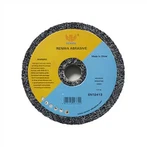
In steelmaking, metallurgy, and mechanical manufacturing, rolls are critical components used to press and shape metal sheets and strips. Their surface condition has a direct impact on the dimensional accuracy and performance of the finished product. To ensure efficient roll refurbishment and precision machining, the manufacturing of roll grinding wheels is particularly important.
The core capability of a roll grinding wheel manufacturer lies in the precise control of the abrasive, bond, and pore structure. Abrasive selection, for example, needs to be based on the roll material, hardness, stock removal requirements, and target surface roughness. Common abrasives include aluminum oxide and silicon carbide, along with newer materials such as zirconia alumina and ceramic alumina. By adjusting the abrasive grit size, bond type-such as vitrified, resinoid, or rubber-and firing temperature, manufacturers can achieve the required hardness, strength, and self-sharpening characteristics.
In actual grinding operations, roll grinding wheels must accommodate different roll lengths and hardness ranges. High-strength tool steel rolls, for example, can reach hardness levels of 79–84 HSD, with roll body lengths of up to 3,450 mm. For these demanding conditions, manufacturers may develop a staged grinding process. During rough grinding, coarse-grit wheels with a higher bond content are used for rapid stock removal. Semi-finishing and finishing operations then switch to finer-grit, harder wheels, with the wheel speed controlled at around 30–40 m/s to reduce chatter marks and improve the surface finish to Ra 3.2 or better. By optimizing the wheel formulation, some manufacturers have increased wheel life by approximately 30% compared with conventional products, reducing wheel changes and machine downtime.
For the selection and use of roll grinding wheels, users often have the following questions:
1. How should the abrasive be selected based on the roll material?
Roll materials vary considerably in hardness and toughness, so abrasive selection needs to match the specific material. High-chromium cast iron rolls are generally suitable for ceramic alumina abrasives such as SG/NQ. Their microcrystalline structure helps maintain sharp cutting edges and reduce grinding burn. Chilled cast iron rolls, meanwhile, can be ground with silicon carbide or zirconia alumina abrasives to balance wear resistance and cutting efficiency.
2. What wheel parameters are required at different grinding stages?
Rough grinding generally requires a coarser grit, such as F36–F46, combined with a relatively hard wheel to withstand heavy feed rates. For finish grinding, a finer grit, typically F80 or finer, together with a more open structure can help achieve the required surface finish. Wheel speed is also important. Excessive speed can increase the risk of grinding burn, while insufficient speed may reduce productivity. A typical working range is around 30–40 m/s, depending on the machine and grinding conditions.
3. How can wheel cost and service life be balanced?
The actual cost of a grinding wheel involves more than its purchase price. Wheel changes, machining efficiency, and machine downtime should all be considered. Premium abrasives such as ceramic alumina may have a higher initial cost but offer good self-sharpening characteristics and longer service life, making them suitable for high-volume, continuous production. Standard white aluminum oxide wheels are more economical and can be suitable for small-batch production or less demanding surface-finish requirements. Trial grinding is recommended to evaluate the total cost per unit of processing time.
4. Can a roll grinding wheel manufacturer provide customized solutions?
Experienced roll grinding wheel manufacturers typically have the technical capability to adjust wheel formulations according to the customer's roll material, machine model, and process parameters. For example, for the ultra-fine grinding of silicon nitride ceramic balls used in bearings, a wheel with an ultra-fine diamond abrasive can be selected to achieve a surface finish as low as Ra 6.5 nm.
In short, the technical capability of a roll grinding wheel manufacturer has a direct influence on roll machining quality and productivity. From abrasive development and process control to individual specifications and complete product ranges, manufacturers are moving toward more precise and intelligent production to provide reliable grinding solutions for key industries such as steel, bearings, and automotive manufacturing.