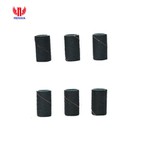
Silicon carbide (SiC) is a hexagonal crystal compound formed by covalently bonding silicon and carbon. It can be divided into two categories based on the production process: black silicon carbide and green silicon carbide. Black SiC, with its high cost-effectiveness and strong adaptability, has become the mainstay of coated abrasives in the mid- and low-end machining applications. Together with green SiC, it forms a core abrasive system covering all scenarios.
Core performance advantages adapt to grinding needs, black silicon carbide has more practical value
The performance characteristics of silicon carbide are highly consistent with the requirements of coated abrasives for "efficient cutting, stable wear resistance, and adaptability to a variety of substrates." Black silicon carbide, while maintaining its core performance, also highlights its practical advantages in adapting to a wide range of processing scenarios:
High hardness and excellent wear resistance, outstanding cost performance:
Silicon carbide has a Mohs hardness of 9.2, second only to diamond (10) and cubic boron nitride (CBN). Its microhardness can reach 2800-3300 kg/mm², far exceeding corundum-based abrasives (brown corundum is approximately 2000 kg/mm²). Although black silicon carbide is slightly less pure than green silicon carbide, its hardness is sufficient for grinding most medium and low hardness materials. At only 60%-70% of the price of green silicon carbide, it can achieve stable wear resistance at a lower cost in batch processing, reduce the rate of abrasive passivation, and extend the service life of the grinding tool.
Good thermal conductivity and heat dissipation to avoid damage to workpieces during conventional processing:
Silicon carbide has a thermal conductivity of approximately 80-150 W/(m・K), 3-5 times that of corundum. This property allows black silicon carbide to quickly dissipate grinding heat when grinding common materials such as cast iron and aluminum alloys, effectively preventing burns and deformation of the workpiece caused by localized high temperatures. This makes it particularly suitable for routine, high-volume machining of hardware and building materials.
Strong chemical stability, adaptable to complex processing environments:
Black silicon carbide does not react with corrosive media such as acids and alkalis at room temperature, and only slightly reacts with strong bases at high temperatures. This characteristic ensures that coated abrasives maintain stable performance in humid building materials processing workshops and mildly corrosive hardware rust removal environments, allowing them to operate normally without additional protection.
Controllable particle size and morphology, covering multiple processing stages:
Through crushing, screening and other processes, black silicon carbide can be prepared into a complete system ranging from coarse particle size (P8-P36) to medium and fine particle size (P120-P400). The abrasive morphology is mainly angular, with strong cutting ability, which can meet most needs from rough processing to semi-finishing such as casting deburring, plate rough grinding, and profile wire drawing. Its adaptability far exceeds that of single-purpose abrasives.