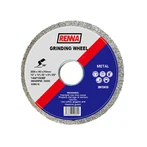
The hardness of a grinding disc refers to the difficulty of the abrasive grains on the surface of the polishing wheel to fall off from the binder under the action of cutting force. If the abrasive grains fall off easily, the hardness of the abrasive tool is low; otherwise, the hardness is high. Be careful not to confuse the hardness of the abrasive tool with the hardness of the abrasive grains themselves. The main factor affecting the hardness of the polishing wheel is the amount of binder. The more binder, the higher the hardness. In addition, in the manufacturing process of the abrasive tool, the forming density, sintering temperature and time will affect the hardness of the abrasive tool.
Grinding discs may suffer varying degrees of damage during use, ranging from minor damage that is difficult to detect to major damage to the entire set and being scrapped. When the polishing disc hits the plate, if there is no or only a little fiber, steam or water in the middle of the polishing disc, the friction heat cannot be absorbed and the surface temperature will rise sharply. The grinding teeth absorb this part of the heat and expand relative to other parts, causing the polishing wheel to bend in the direction of the heat source. It is like using a gas cutting gun to quickly heat a piece of steel plate, and the steel plate will bend in the direction of the cutting gun. Frictional heat cannot be quickly transferred in the grinding wheel, which will cause a temperature difference between the two sides of the grinding disc. When the friction is severe, the temperature on the back of the grinding wheel is consistent with the operating temperature of the hot grinder, but the temperature of the grinding teeth may reach its melting point.
When two grinding discs touch the disc, they will bend and deform towards each other, causing greater heat accumulation and bending. A slight contact with the disc will leave a slight scratch on the grinding tooth surface. In most cases, the grinding wheel can continue to be used until it is replaced. If the grinding disc is inspected at this time, it will be found that except for many horizontal scratches on the grinding tooth surface, the grinding wheel looks normal, but its service life will be reduced and the fiber quality will be reduced.
The general principle of selecting the hardness of the grinding disc is:
When grinding hard materials, soft grinding discs should be used to maintain good "self-sharpening", increase the service life of the grinding wheel, and reduce grinding force and grinding heat; when grinding soft materials, hard grinding wheels should be used to keep the abrasive micro-edges sharp for a longer time, which is conducive to cutting.
The specific situation is as follows:
1. When grinding non-ferrous metal workpieces with high toughness, tools with high grinding hardness, thin-walled parts and materials that have clogged the grinding wheel, softer grinding discs should be used; super-soft grinding discs should be used for mirror grinding.
2. When the workpiece material is the same, longitudinal grinding and cut-in grinding, peripheral grinding and end face grinding, cylindrical grinding and internal cylindrical and surface grinding, wet grinding and dry grinding, fine grinding and rough grinding, intermittent surface grinding and continuous surface grinding, etc., the former should use harder grinding discs than the latter.
3. For high-speed, high-precision grinding, steel blank grinding, workpiece deburring, etc., harder grinding discs should be selected.
Generally speaking, when high efficiency, large surface roughness value, large contact surface between grinding disc and workpiece or grinding disc on workpiece bevel, high toughness and elongation of workpiece material, and processing thin-walled workpieces, larger particle size should be selected; on the contrary, when processing high hardness, large brittleness, and densely organized materials; fine grinding, forming grinding or high-speed grinding, smaller particle size should be selected. The commonly used grit size is 46-80. Coarse-grained grinding discs are used for rough grinding, and fine-grained grinding discs are used for fine grinding. In addition, the end grinding disc should be coarser than the peripheral grinding disc; the internal grinding wheel should be coarser than the cylindrical grinding wheel; and the dry grinding wheel should be coarser than the wet grinding wheel.