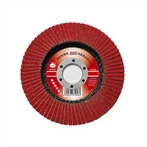
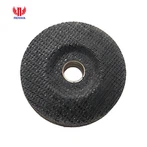
Brown fused alumina has a very high hardness, but grinding wheels made from it can be either superhard or soft. Why is this? Why can grinding wheels made from the same raw material, brown fused alumina, have different hardness levels?
It turns out that the hardness of a brown aluminum oxide grinding wheel is not determined by the abrasive itself, but by the binder used to make the wheel. There are many binders used to make grinding wheels, commonly including ceramics, resins, and rubber. Grinding wheels made with these three types of binders are respectively called hard grinding wheels, medium-soft grinding wheels, and soft grinding wheels.
Why are brown aluminum oxide grinding wheels made into these three different types? The main difference lies in their applications. Hard grinding wheels are those where the abrasive particles are difficult to detach from the wheel. In cutting soft metals, where it's crucial that the abrasive particles are difficult to detach, hard grinding wheels are used. However, in processing hard metals, to prevent the surface layer of abrasive from becoming dull after grinding, it's generally desirable for the abrasive particles to detach more easily, exposing a new layer and increasing cutting power. In this case, soft grinding wheels are typically used.
Here are five key characteristics of brown aluminum oxide grinding wheels. Understanding these characteristics will help us understand why they are so popular.
1. Brown aluminum oxide grinding wheels can perform grinding operations continuously for a long time without generating too much grinding heat or clogging.
2. Brown aluminum oxide grinding wheels can be used for grinding materials of different hardness, and have excellent effects on grinding curved surfaces and special metals.
3. Brown aluminum oxide grinding wheels can provide a larger cutting volume and a uniform surface grinding effect, and can also reduce fine grinding time and eliminate some machining steps.
4. Suitable for ordinary grinding of workpieces made of high-strength and high-hardness materials such as quenched steel, high-speed steel, and high-carbon steel. It can also be used for machining threads, gears, and thin-walled parts.
5. Used for internal and external grinding, surface grinding, centerless grinding, tool grinding, and various special-purpose grinding machines and semi-precision grinding.