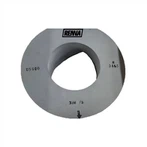
White aluminum oxide grinding wheels have good performance and wide applications. However, during production, some grinding wheels are often found to turn red after firing in a tunnel kiln. To find the cause of this reddening, their cross-sections were opened for observation, revealing that the internal and external colors were the same.
Grinding wheels from the same batch exhibited both red and white colors, severely affecting their appearance quality. Why do the grinding wheels turn red after firing? What kind of coloring substance plays a role during firing? It is generally believed that this phenomenon is caused by the strong oxidizing environment inside the kiln and the iron content in the grinding wheels themselves.
When analyzing the reasons for the red color of grinding wheels during sintering, some people believe that the red color of white aluminum oxide grinding wheels is due to insufficient oxidizing atmosphere during sintering. How can we find the correct answer amidst so many speculations? Actually, it's quite simple; this can be verified through testing.
The raw material, white fused alumina abrasive, is white. The reason the produced product is red is likely related to the calcination environment. Take two grinding wheels of different shades from those that turned red after exiting the kiln, and divide each into three parts.
When loading them into the furnace, divide them into three groups, with one dark-colored wheel paired with one light-colored wheel in each group. Place the two groups in different parts of the furnace, leaving one group outside for comparison. Remember to surround each group of samples with some silicon carbide artifacts during verification.
Set the firing time to six hours. When power is initially supplied, adjust the voltage regulator to level two, allowing it to heat up freely. When the temperature rises very slowly, adjust the voltage regulator to a higher level.
Once the temperature reaches the set temperature, cut off the power and allow it to cool naturally. Remove it from the furnace when the temperature drops to 120 degrees Celsius. The purpose of the experiment was to verify whether white aluminum oxide grinding wheels that had turned red in color after being fired in a tunnel kiln could be restored to their original white state by being refired in a furnace with a reducing atmosphere.
After two experiments, it was found that the red color inside and on the surface of the white aluminum oxide grinding wheel disappeared after reheating, and its whiteness was even whiter than that of the non-reddened wheel.
This fully demonstrates that the reddening of the grinding wheel after firing is indeed caused by a strong oxidizing atmosphere.
Most of the ferric oxide contained in the grinding wheel itself comes from the binder. This iron decomposes and manifests as ferric oxide. In reality, the iron present in minerals includes both low-valence and high-valence iron.
These iron compounds are bound together in the mineral as extremely small particles. Generally, ferric oxide is red to brown, while iron oxide is gray or bluish-green.
From the above analysis, it can be seen that the reddening of white aluminum oxide grinding wheels is related to the environment. A strong oxidizing atmosphere easily causes a reaction, turning the grinding wheel red. Furthermore, it has been verified that the hardness of the reddened grinding wheel is slightly lower than that of the non-reddened wheel.
And generally speaking, for grinding wheels of the same specification, the lower the hardness, the lower the strength. Therefore, whether from the perspective of appearance or performance, white aluminum oxide grinding wheels should be fired in a neutral or weakly reducing atmosphere.