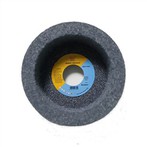
According to different process purposes and requirements, there are many forms of flap disc grinding process methods, and its main purpose is to remove excess material from the workpiece. So what issues should be paid attention to when grinding the inner hole of the discontinuous surface with a flap disc?
1. When there are wide grooves, keyways, or radial through holes on the surface of the inner hole, the inner hole is very likely to have shape errors due to the discontinuous contact between the flap disc and the hole wall during the grinding process, so corresponding measures must be taken.
2. When grinding holes with wide grooves on the surface of the inner hole, it is easy to produce bell mouths at both ends of the wide grooves. The measures that should be taken are: try to use a larger diameter extension shaft; appropriately increase the width of the flap disc and use diamond to trim the flap wheel in time.
3. When grinding holes with keyways on the surface of the inner hole, it is often easy to produce "collapse angles" at the edge of the keyway. At this time, the diameter of the flap wheel can be appropriately increased, the width of the flap wheel can be reduced, and the rigidity of the extension shaft can be increased. For inner holes with higher precision, hardwood or bakelite can be embedded in the keyway before grinding the inner hole.
4. When grinding holes with radial through holes on the surface of the inner hole, polygons are easy to form on the hole wall. At this time, it can be prevented by appropriately increasing the diameter of the flap disc, using materials with good rigidity as the extension shaft, and trimming the flap wheel in time. When fine grinding the above three types of intermittent surface holes, the back cutting amount should be reduced and the number of "finishing grinding" should be appropriately increased to ensure the processing accuracy and surface roughness of the holes.
The above are the issues that need to be paid attention to when grinding the inner hole of the intermittent surface of the flap disc. In addition to these precautions, it is also necessary to pay attention to the grinding direction being basically perpendicular to the grinding direction to avoid surface cracks that affect the appearance of the parts, and in severe cases will directly affect the quality of the parts.