◆ Ordinary cylindrical grinding
Ordinary cylindrical grinding uses the top holes at both ends of the workpiece to support the workpiece between the headstock and the top of the tailstock of the grinding machine. During grinding, the workpiece rotates under the drive of the spindle, and the grinding wheel feeds laterally.

◆ Centerless Cylindrical Grinding
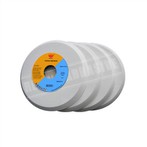
Centerless cylindrical grinding has no headstock and tailstock, but supports the workpiece by a pallet and a guide wheel, and grinds it with a grinding wheel. The centerless grinding method is composed of three mechanisms: grinding wheel, adjustment wheel and workpiece support. The grinding wheel actually performs the grinding work. The adjustment wheel controls the rotation of the workpiece and makes the workpiece feed speed. The workpiece support is grinding. Support the workpiece when cutting. Centerless cylindrical grinders have higher productivity. It is mostly used in mass production and is easy to automate.
◆ The characteristics of centerless cylindrical grinding compared with ordinary cylindrical grinding
1. Continuous processing, no need to retract the tool, short time for clamping the workpiece, high productivity.
2. The bracket and guide wheel positioning mechanism have better supporting rigidity than the top and center frame mechanism of the common cylindrical grinder, and the cutting amount can be larger, which is conducive to the processing of slender shaft workpieces, and is easy to achieve high-speed grinding and strong grinding.
3. The workpiece of the centerless cylindrical grinder is positioned on the positioning mechanism by the outer circle, and the grinding amount is the allowance on the diameter of the workpiece. Therefore, the wear of the grinding wheel, the compensation of the feeding mechanism and the repeated positioning accuracy error of the plunging mechanism affect the dimensional accuracy of the diameter of the part. , only half of the ordinary cylindrical grinder, no need to punch the center hole, and easy to automate the loading and unloading in advance.


4. The centerless grinding machine with wide grinding wheel has a pass-through mechanism, which can increase the machining allowance each time. During plunge grinding, it can grind complex profiles sequentially or grind multiple grinding wheels, with high productivity and wide application range.
5. The centerless cylindrical grinder does not have a mechanism to ensure the relative position accuracy (coaxiality, perpendicularity, etc.) of the grinding surface and the non-grinding surface, and the roundness is poor when grinding the circumferentially interrupted outer surface.
6. The grinding surface is prone to odd-numbered edge roundness, and if it is larger, it will often cause the illusion that the measured size is smaller than the maximum physical size, which will affect the assembly quality and work performance.
7. The adjustment of the machine tool is complicated and time-consuming. Every time a workpiece of different diameter is replaced, the height of the bracket, the distance and the related process parameters need to be adjusted. Therefore, it is difficult to adjust the technology, and it is not suitable for small batch and single-piece production.