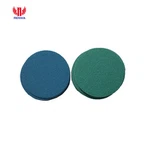
Metallographic sandpaper is one of the most commonly used consumables in metallographic laboratories. Silicon carbide (SiC) waterproof abrasive paper is particularly popular because it provides efficient material removal and can generally be used with water as a lubricant and coolant. It is an essential tool for both coarse and fine grinding during routine metallographic sample preparation.
Metallographic sandpaper is available in a wide range of grit sizes, from coarse to fine. Choosing the right grit sequence is important for removing surface damage, improving flatness, and preparing the sample for polishing and etching. So, how should you select a suitable grinding procedure?
In most cases, the choice depends more on the initial surface condition of the sample than on the material itself. Important factors include surface roughness, flatness, cutting marks, burrs, and the depth of the deformation layer. A typical grinding sequence may progress from P80 to P2000 in four to six steps. If a finer finish is required, additional grinding with P1500 to P4000 abrasive paper may be used before final polishing. The actual sequence should be adjusted according to the sample condition and the requirements of the metallographic analysis.
How to Select the Starting Grit
When you receive a sample, first inspect its surface carefully. Check its flatness, visible cutting marks, burrs, surface finish, and any signs of oxidation or corrosion. These observations help you assess how much material needs to be removed and determine the starting grit for the first grinding stage.
If the surface is rough and has obvious saw or cutting marks, start with coarse P80 metallographic sandpaper to remove the damaged layer efficiently. If the surface is already relatively flat and smooth, you may be able to start with P240 instead. This avoids unnecessary material removal, reduces abrasive consumption, and saves preparation time.
Recommended Grinding Sequences for Different Materials
For harder materials, a gradual grit progression is generally recommended. A typical sequence is P80, P240, P400, P600, P800, P1000, P1500, and P2000. Each stage should remove the scratches left by the previous one before moving to a finer grit.
During grinding, inspect the sample regularly rather than following the sequence mechanically. Depending on the surface condition and inspection requirements, some intermediate grits, such as P800, P1000, P1500, or P2000, may be skipped. In certain cases, the process can move directly from an appropriate grinding stage to diamond polishing suspension.
For relatively soft materials, such as some grades of cast iron, the grinding sequence may also be shortened. Depending on the material structure and the condition of the sample, P400 or P800 may be unnecessary. However, soft materials can be more susceptible to deformation, smearing, or abrasive embedding, so the grinding pressure and abrasive sequence should be selected carefully.
There is no single grinding procedure suitable for every metallographic sample. Different materials and inspection objectives require different surface preparation methods. The grit sequence should therefore be adjusted based on actual grinding results, with experience helping operators develop more efficient procedures for familiar materials.
Key Features of Metallographic Sandpaper
Electrostatic Abrasive Coating Process
Specialized metallographic sandpaper is made with carefully selected silicon carbide grains featuring a consistent particle size and sharp cutting edges. An electrostatic coating process helps distribute the abrasive grains evenly across the backing, providing consistent grinding performance, efficient cutting, and good wear resistance.
Fast Material Removal
High-quality silicon carbide abrasive paper removes material efficiently while helping minimize the depth of the deformation layer. It is particularly effective for hard and high-hardness materials.
Its waterproof construction also makes wet grinding possible throughout the coarse and fine grinding stages. Using water as a lubricant and coolant helps reduce heat and remove grinding debris, minimizing the risk of abrasive loading and sample smearing.
Imported Latex Paper Backing
The paper backing is made from thick, high-quality latex paper designed to withstand repeated exposure to water. Compared with conventional paper-backed sandpaper, it offers better water resistance and durability, allowing longer use under suitable grinding conditions.
Adhesive Backing for Easy Replacement
An optional pressure-sensitive adhesive backing makes the abrasive paper easy to attach and remove. It also helps prevent the edges from lifting or curling during wet grinding, keeping the paper securely in place throughout sample preparation.
Recommended Accessories
Non-Stick Mounting Disc
A non-stick mounting disc features a specially treated surface that allows adhesive-backed metallographic sandpaper or polishing cloths to be attached securely and removed easily. It simplifies abrasive replacement and helps prevent adhesive residue from building up on the mounting surface.
Choosing the right metallographic sandpaper, grit sequence, and polishing accessories can make sample preparation more efficient and consistent. By matching the abrasive to the material and initial surface condition, laboratories can achieve a cleaner surface and more reliable results for subsequent metallographic examination.