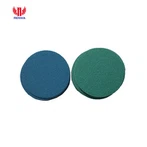
The sanding process has the characteristics of high production efficiency, good surface quality and low production cost. Therefore, it is widely used in various productions. The final surface quality of the product is closely related to the sanding process. The abrasive belt is the main tool of the sanding process. How to choose a suitable abrasive belt, extend the service life of the abrasive belt, and further improve the finish and flatness of the sanding are common problems encountered in the use of abrasive belts. With the advancement of science and technology, the belt base of the abrasive belt, the type of abrasive, the production process of the abrasive belt, and the binder of the abrasive are constantly improving.
The coarseness of the abrasive particle size has a great influence on the productivity of sanding and the roughness of the processed surface. Generally speaking, coarse grain size is used for rough grinding, high plasticity, large grinding area, to avoid chip embedding, soft workpieces, etc.; fine grain size is used for fine grinding and hard workpieces.
Performance characteristics of abrasives
|
Abrasive Type |
Main Features |
Main application areas |
|
Brown aluminum oxide |
Strong anti-crushing ability, anti-oxidation, anti-corrosion, good toughness |
Used for grinding metal materials with high tensile strength, such as ordinary carbon steel, hard bronze, alloy steel, malleable cast iron, etc. |
|
Zirconia fused alumina |
Greater toughness |
Suitable for high-speed heavy-load grinding, can grind cast iron, cast steel, alloy steel and high-speed steel, etc., especially suitable for grinding titanium alloy, heat-resistant alloy, high-vanadium steel and stainless steel. |
|
Black silicon carbide |
High hardness, high brittleness |
Suitable for processing metal materials and non-metal materials with low tensile strength, such as gray cast iron, brass, lead and other non-ferrous metals, ceramics, glass, stone and other hard and brittle materials |