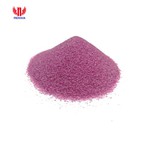
The industrial production method of black silicon carbide is to use quartz sand and petroleum coke to refine in a resistance furnace. The refined silicon carbide blocks are crushed, acid-base washed, magnetically separated, and sieved or water-selected to produce products of various particle sizes. So what is the hardness of black silicon carbide and its detection method?
Hardness of black silicon carbide:
The Mohs strength of black silicon carbide is 9.2-9.5, and in the model hardness table, the strength reaches 9. Silicon carbide is also a wear-resistant material between corundum and diamond, with higher mechanical strength than corundum. And it has good wear resistance and is the material of choice as an abrasive.
Among abrasive molds, only materials with high strength and good wear resistance are selected for molds. Whether the grinding wheel is wear-resistant or not, and whether it consumes quickly or slowly, can be obtained through simple tests to obtain more accurate data.

The hardness test methods of black silicon carbide are as follows:
1. Atomic absorption: This test method can detect the silicon content and determine the hardness of black silicon carbide. The test value is relatively accurate.
2. Resistance method particle analysis: The resistance method particle analyzer is used to measure the particle size of black silicon carbide, which can effectively determine the cutting property of black silicon carbide and has a relatively high test efficiency.
3. Particle analyzer: The coefficient measurement of particle shape is very accurate, which is an effective method for detecting the cutting efficiency and cutting quality of black silicon carbide.