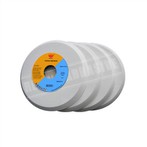
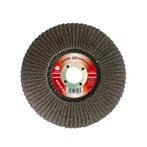
If we compare a vitrified grinding wheel to a precise grinding warrior, then the abrasive, bonding agent, and pores are its "teeth, bones, and breathing channels." These three components together constitute the grinding wheel's "internal organs," determining its combat effectiveness on the metal battlefield. Today, we'll delve into the core secrets of this industrial weapon.
Abrasives: The "teeth" of vitrified grinding wheels-who is responsible for charging into battle?
Abrasives are the vanguard in directly "biting" off metal shavings, requiring extremely high hardness, sharp edges, and heat resistance. The commonly used abrasive families in vitrified grinding wheels fall into two main categories:
Corundum (Alumina) – A Veteran Powerhouse
Brown Aluminum Oxide (A): Contains TiO₂, maximum toughness, ideal for grinding "hard nuts" like carbon steel and cast iron.
White Aluminum Oxide (WA): Up to 99% purity Al₂O₃, excellent for grinding precision tool steel and high-speed steel.
Pink Aluminum Oxide (PA): Contains Cr₂O₃, exceptional thermal stability, a nemesis of stainless steel and heat-resistant alloys.
Silicon Carbide – Specialized Cutting Tools
Black Silicon Carbide (C): Harder than corundum but more brittle, easily grinds cast iron and brass.
Green Silicon Carbide (GC): Hardest only after diamond, a dedicated "surgical knife" for cemented carbide and ceramics.
Quick Reference for Technical Specifications
|
Abrasive Type |
Applicable Materials |
Recommended Granularity |
Core Advantages |
|
Brown aluminum oxide |
Carbon steel, cast iron |
36#-120# |
Excellent toughness |
|
White aluminum oxide |
High-speed steel, alloy steel |
60#-240# |
High precision |
|
Pink aluminum oxide |
Stainless steel |
80#-180# |
High temperature resistance |
|
Silicon carbide |
cemented carbide |
46#-180# |
Super hard and sharp |
Bonding agent: The "skeleton" of vitrified grinding wheels - how to hold the entire field?
The binder is the "commander" of the abrasive, responsible for binding them together and maintaining their strength. Ceramic binders (marked V) are undoubtedly the star:
The "Forging" of Ceramic Binders
Made primarily of feldspar and soluble clay, these are mixed with abrasives and sintered at 1300°C. This process gives ceramic binders:
✅ Extremely high holding power: The abrasives are firmly locked in, preventing them from easily detaching.
✅ Heat and corrosion resistant: Impervious to water and fire, chemically stable.
✅ High rigidity: High elastic modulus, minimal grinding deformation, and micron-level precision.
Comparison with other binders:
|
Type |
Code Name |
Advantage |
Shortcoming |
Applicable Scenarios |
|
Ceramic |
V |
High precision, long lifespan, and heat resistance |
Not shock resistant |
Precision grinding, high-speed grinding |
|
Resin |
B |
High speed and impact resistant |
Not resistant to water or high temperatures |
Cutting disc, polishing |
|
Metal |
M |
Super wear-resistant and high load capacity |
Poor self-sharpening ability and difficult to repair |
Superhard abrasive |
Pores: The "breathing channels" of vitrified grinding wheels-a hidden key to success.
Porosity is the "black technology" of vitrified grinding wheels; seemingly hollow, it's key to efficiency:
Three Core Functions
Chip Removal Channel: Forms a honeycomb structure, allowing chips to escape through the holes, preventing blockage and workpiece burns.
Heat Dissipation Powerhouse: The pores create air convection, increasing heat dissipation efficiency by over 40% compared to ordinary grinding wheels.
Pressure Buffer: Reduces contact pressure by 30-50%, especially suitable for thin-walled workpieces and soft materials.
The "Superpowers" of Large Porosity Grinding Wheels
Through the addition of porosilicate agents and sintering processes, the porosity volume ratio can reach 35%-50%, with pore diameters of 0.7-1.4mm (up to 15mm for special requirements). This structure allows for:
a 10-15% increase in material removal rate
a 1.5-2 times increase in tool life
a significant reduction in grinding temperature, preventing workpiece deformation
Key parameters: 10# microstructure corresponds to the lowest porosity; pore size must match the abrasive grain size; large pores for rough grinding, small pores for fine grinding.
Trinity: Collaborative operations are the key to victory
Looking at any one factor alone is insufficient; all three must be precisely matched:
Abrasive hardness determines "clamping force"
Bond strength determines "support force"
Porosity structure determines "continuous operation capability"
For example, grinding hardened steel: White aluminum oxide (WA) + medium-hard ceramic bond + medium porosity = high efficiency and precision; grinding stainless steel: Pink fused alumina (PA) + hard ceramic bond + large porosity = a powerful tool against burns.