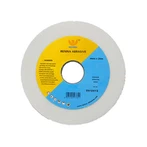
A rail grinding wheel is a tool specifically designed for grinding and finishing the surface of rails. It consists of abrasive, bonding agent, and a matrix. The abrasive is the core component of the grinding wheel and is typically made of extremely hard materials such as diamond, cubic boron nitride (CBN), corundum, and silicon carbide. These materials give the grinding wheel its powerful grinding capabilities. The bonding agent firmly binds the abrasive together, maintaining the stability of the wheel's structure during high-speed rotation and grinding. The matrix provides support for the entire grinding wheel, ensuring it can withstand various forces during operation.
Its working principle is based on the fundamental principle of friction grinding. When the grinding equipment drives the rail grinding wheel to rotate at high speed, the abrasive on the wheel surface comes into close contact with the rail surface. Due to the high-speed rotation of the grinding wheel, a huge frictional force is generated between the abrasive and the rail. This frictional force can overcome the bonding force of the rail surface material, gradually grinding away the tiny protrusions, defects, and wear layers on the rail surface. During the grinding process, the grinding wheel will precisely grind the rail according to pre-set parameters, such as grinding angle, pressure, and speed, to eliminate defects and restore the geometry and smoothness of the rail surface.
Depending on the abrasive, bonding agent, and structural design, rail grinding wheels can be classified into several types. According to the abrasive, there are diamond wheels, CBN wheels, corundum wheels, and silicon carbide wheels, as mentioned earlier. Diamond wheels, with their extremely high hardness and wear resistance, perform excellently in the fine grinding of high-speed, heavy-load railway rails, efficiently removing wear layers and defects from the rail surface with high grinding precision, effectively extending the service life of the rails. CBN wheels, with a hardness second only to diamond, possess good thermal stability and chemical inertness, offering unique advantages when grinding high-hardness alloy rails, reducing wheel wear and improving grinding efficiency. Corundum wheels have good toughness and grinding performance, suitable for grinding general railway rails, and are relatively inexpensive. Silicon carbide wheels have moderate hardness and are inexpensive, commonly used for grinding ordinary rails, meeting basic grinding requirements.
From the perspective of the bonding agent, common types include resin-bonded grinding wheels, ceramic-bonded grinding wheels, and metal-bonded grinding wheels. Resin-bonded grinding wheels have high strength and good elasticity, effectively buffering grinding forces during grinding and reducing damage to the rails. They also have good self-sharpening properties, maintaining good grinding results, and are widely used. Ceramic-bonded grinding wheels have good heat resistance, chemical stability, and wear resistance, making them suitable for high-precision, high-efficiency grinding operations, but their cost is relatively high. Metal-bonded grinding wheels have high bonding strength and wear resistance, and are often used in the manufacture of diamond and CBN grinding wheels to meet grinding requirements under special working conditions.
Furthermore, based on their structural form, rail grinding wheels can be categorized into ordinary grinding wheels, perforated grinding wheels, and layered grinding wheels. Different structures of rail grinding wheels possess unique characteristics in terms of grinding performance, heat dissipation, and chip handling, adapting to various grinding scenarios and types of rail defects.