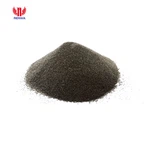
Tabular sintered fused alumina is a high-end refractory raw material that has been rapidly promoted in the refractory industry in the past 30 years. It has partially replaced traditional white corundum, sub-white corundum, and brown aluminum oxide in the fields of high-performance refractory products such as carbon-free refractory materials for steel refining ladles, functional refractory materials, and high-throughput iron channel castables. In recent years, with the optimization of the production process of tabular sintered fused alumina by enterprises, the significant increase in production capacity, and the continuous reduction in production costs, the technical and economic advantages of tabular sintered fused alumina have been further improved, and sub-white corundum and brown aluminum oxide no longer have price advantages. The share of brown fused alumina in the refractory raw material market that has been retained in some special scenarios will be further replaced.
Production Process
The common production process of tabular sintered fused alumina is industrial alumina powder-grinding-adding water to form balls-drying-high-temperature sintering in a vertical kiln-crushing-packaging. The sintering equipment is a high-temperature vertical kiln, which uses clean energy natural gas as fuel. After sintering at 1900~1950℃ in the vertical kiln, the transition phases such as γ-Al2O3 of industrial alumina powder are converted into the most stable α-Al2O3 phase. The sintering process of rapid sintering and rapid cooling is adopted. The grain size of tabular sintered fused alumina is generally within 30~150μm. Due to the rapid cooling, there are a large number of intracrystalline micropores in the tabular sintered fused alumina, and most of the pores are nanometer-level. Due to the existence of these closed micropores, the tabular sintered fused alumina has excellent thermal shock resistance.
Brown aluminum oxide is obtained by electric melting. The three raw materials of high-alumina bauxite clinker, carbon material, and iron scraps are mixed and added to the electric arc furnace. After high-temperature melting and impurity reduction, they are cooled and crystallized into brown molten blocks. The mineral composition is mainly α-Al2O3 phase, the crystal shape is rhombus, thick plate and cracked particles in the center, and there are more titanium oxide, silicon oxide, calcium oxide melt crystals around, which are long plate-shaped, and the coarsest grains are skeletal lamellae. Because the impurities have not been completely removed, brown corundum also contains calcium hexaaluminate, calcium plagioclase, spinel, rutile and other secondary crystal phases and glass phases, iron alloys and solid solutions. The color tone of brown corundum depends largely on the titanium oxide remaining in the product.
Features Of Use
The sintering process of tabular sintered fused alumina is rapid sintering and rapid cooling, so there are a large number of intracrystalline micropores inside the grains, most of which are nanometer-level. The existence of these closed micropores effectively resists thermal shock and prevents crack diffusion, making tabular sintered fused alumina have better thermal shock resistance.
Brown aluminum oxide has more open pores and fewer closed pores, and forms larger single crystals during a slower cooling process. And because it contains more impurities, the intercrystalline defects are larger. These single crystals produce cracks during the crushing process, thereby reducing the thermal shock resistance and spalling resistance.
It is worth noting that the pulverization and cracking problem of brown aluminum oxide cannot be ignored. Since the raw material used for brown aluminum oxide is bauxite, which contains a large amount of impurities such as silicon, iron, and titanium, coke is required as a reducing agent for desiliconization. If the treatment is not in place during the smelting process, aluminum carbide impurities will be formed when the residual carbon content is high, and aluminum carbide is easily powdered when it encounters water. After such brown aluminum oxide particles are used in products, the products will crack or peel off. However, tabular sintered fused alumina does not require the use of reducing agents such as coke due to the low impurity content of the raw materials. Therefore, the final product contains more than 99.5% (w) Al2O3, so there is no risk of cracking and powdering.