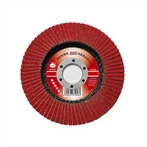
Silicon carbide (SiC) is a high-hardness artificial abrasive. Its hardness (Mohs 9.5) is second only to diamond and cubic boron nitride (CBN). It is particularly suitable for grinding hard and brittle materials (such as cemented carbide, ceramics, glass) or low-strength metals (such as aluminum and copper). Among them, black silicon carbide (C/TH) and green silicon carbide (GC/TL) are the two most commonly used types, but their composition, performance and applicable scenarios are significantly different. This article will compare the two from the dimensions of hardness, toughness, thermal conductivity, etc., and provide selection recommendations.
Depth comparison of black silicon carbide and green silicon carbide
1. Ingredients and manufacturing process
|
Characteristics |
Black silicon carbide(C/TH) |
Green silicon carbide(GC/TL) |
|
Element |
SiC purity is about 97%~98%, containing a small amount of impurities (such as Fe₂O₃) |
SiC purity>99%, almost no impurities |
|
Manufacturing process |
Quartz sand + petroleum coke high temperature smelting (2200℃) |
High purity quartz sand + petroleum coke, higher temperature (2500℃) |
|
Color |
Black |
Green (optical properties due to high purity) |
|
Key Difference: Green silicon carbide is purer and has a more complete crystal structure, making it harder and more brittle. |
||
2. Comparison of physical properties
|
Characteristics |
Black silicon carbide(C) |
Green silicon carbide(GC) |
|
Hardness |
9.2~9.3 (slightly lower than GC) |
9.4~9.5 (currently the hardest type of silicon carbide) |
|
Toughness |
Higher, better impact resistance |
Low, easy to break |
|
Thermal conductivity |
Higher (fast heat dissipation, suitable for continuous grinding) |
Slightly lower (grinding temperature needs to be controlled) |
|
Abrasive sharpness |
General (edges and corners are easily blunted) |
Extremely sharp (suitable for precision machining) |
Core conclusion:
Black silicon carbide: It has both hardness and toughness, and is suitable for rough grinding or intermittent processing.
Green silicon carbide: It has ultra-high hardness but high brittleness, and is suitable for fine grinding or superhard materials.
3. Typical application scenarios
|
Material Type |
Recommended SiC Types |
Reason |
|
Cast iron, brass, aluminum |
Black silicon carbide(C) |
Sufficient toughness, avoiding premature breakage of abrasive particles, and good economic efficiency. |
|
Cemented Carbide (YG Type) |
Green silicon carbide(GC) |
High hardness can effectively cut WC-Co alloy and avoid adhesion. |
|
Ceramics, glass |
Green silicon carbide(GC) |
High-purity GC abrasive grains are sharper and can reduce material edge chipping. |
|
Rubber, plastic |
Black silicon carbide(C)+Large hole grinding wheel |
The loose structure prevents clogging, and the cost of black silicon carbide is lower. |
How to choose a silicon carbide grinding wheel?
Black silicon carbide (C) is preferred: Processing low-strength metals (aluminum, copper, cast iron). Limited budget or need for high-toughness grinding wheels (such as heavy-duty rough grinding).
Green silicon carbide (GC) is preferred: Fine grinding of superhard materials (carbide, ceramics, gemstones). Requires extremely high surface finish (such as optical glass polishing).
Notes:
Coolant usage: Green silicon carbide is prone to thermal cracking, so it is recommended to use sufficient coolant.
Grit size matching: 36#~80# for coarse grinding and 100#~W40 for fine grinding.