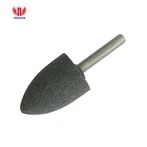
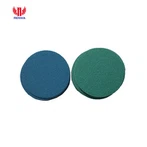
In modern manufacturing workshops, CNC machine tools, CNC grinding machines, and five-axis machining centers have almost become the main players. However, what truly determines the details and quality of a product is often the simplest hand tools-abrasive cloth and honing stones. They are inexpensive, yet they can solve detailed problems that equipment cannot handle, making them essential "invisible weapons" on every machinist's workbench.
I. Why are abrasive cloth and honing stones still irreplaceable?
Limitations of machine tools:
Even with high-precision CNC machining, tool marks, burrs, and sharp edges will still remain.
Challenges of complex cavities:
Molds and parts often have deep grooves and internal corners that the cutting tools cannot fully access.
Surface quality requirements:
From the discharge marks left by electrical discharge machining to the rough surfaces after welding, manual finishing is required.
Therefore, abrasive cloth and honing stones are always the "finishing touches" in precision machining.
A simple summary of experience is: abrasive cloth addresses the "surfaces," and honing stones address the "points."
II. abrasive cloth: Flexible removal and large-area treatment
Abrasive cloth, also known as coated abrasive, typically consists of a fabric backing, an adhesive, and abrasive particles.
1. Engineering Characteristics
Flexibility: Adapts to the curved surface of the workpiece, suitable for large-area grinding.
Wide Grit Range: Coarse grit sandpaper (P40-P120) is suitable for deburring and rust removal; fine grit sandpaper (P400-P2000) can be used for polishing pretreatment.
Cuttable: Can be cut into strips, rolls, or belts to suit different workstation needs.
2. Common Applications
Deburring after machining: For example, after turning shaft parts, abrasive cloth can be wrapped around the shaft and rotated to remove fine burrs.
Surface pretreatment: Sandpaper is commonly used for surface preparation before painting or electroplating to improve adhesion.
Mold finishing: Used in conjunction with wooden or metal strips, it can reach into the corners and edges of the mold cavity.
Tip: When sanding, maintain a consistent direction to avoid "cross-hatching," especially on parts that will have subsequent decorative finishes or coatings.
III. Sharpening Stones: A powerful tool for fine-tuning and localized control.
An sharpening stone is a bonded abrasive tool, formed by sintering abrasive grains with a binder.
1. Engineering Characteristics
High hardness and wear resistance: More suitable for fine grinding and precise shaping.
Diverse shapes: Rectangular blocks, triangular rods, and cylindrical rods are available to suit different geometric features.
Used with lubricants: Kerosene and grinding oil are commonly used to prevent clogging and ensure a smooth finish.
2. Common Applications
Sharpening of cutting tool edges: Extends the lifespan of tools such as turning tools and boring tools.
Finishing of EDM (Electrical Discharge Machining) marks on molds: After electrical discharge machining, sharpening stones are commonly used for progressive grinding until the polishing stage.
Chamfering of precision parts: For hydraulic valve cores, bushing holes, etc., sharpening stones are used to gently refine the transition radius.
Note: Avoid "dry grinding" when using sharpening stones, otherwise clogged abrasive grains will scratch the workpiece.
IV. abrasive cloth vs. honing Stones: A Comparison of Techniques and Applications
|
Item |
Abrasive Cloth |
Honing Stones |
|
Flexibility |
High performance, suitable for curved surfaces and large-area processing. |
Low, mainly used for local and linear features. |
|
Removal efficiency |
Relatively fast, suitable for large-scale rough grinding. |
Slower, suitable for precise control. |
|
Surface quality |
Depending on the granularity, the scope can be large. |
Stable and precise, suitable for fine machining. |
|
Typical applications |
Rust removal, deburring, and surface priming. |
Tool sharpening and mold cavity finishing |
|
position |
"Rough repair & Surface repair" |
"Detailed Repair & Spot Repair" |
In practical engineering, sandpaper is often used first to quickly refine large surfaces; then honing stones are used to refine details and edges.
For example, a common process in the mold industry is:
Electrical discharge machining → Coarse sandpaper cleaning → Honing stone fine finishing → Sandpaper/polishing paste polishing
This combination of techniques is almost an "unspoken standard" in all mold factories.
V. Common Mesh Sizes and Corresponding Roughness Levels
The "P" number of abrasive cloth (FEPA grit standard) typically corresponds to surface roughness as follows (empirical values):
|
Abrasive grit size(P) |
Average particle size(μm) |
Machined surface roughness Ra (μm) |
Application Scenarios |
|
P40–P80 |
200–500 |
Ra 6.3–12.5 |
Rough grinding, slag removal, and heavy burr removal. |
|
P120–P240 |
60–125 |
Ra 3.2–6.3 |
General deburring, priming before painting. |
|
P400–P800 |
20–35 |
Ra 0.8–3.2 |
Precision parts pretreatment, transitional surface finishing |
|
P1000–P2000 |
5–15 |
Ra 0.2–0.8 |
Preparation before polishing, preliminary processes before mirror finishing. |
Tips and techniques: When sanding with abrasive cloth, maintain a single direction to avoid creating cross-hatching patterns, especially on parts that will be subsequently electroplated or oxidized.
VI. Sharpening Stones: Fine-tuning and localized control
The grit size of honing stones is generally indicated by a '#' symbol (according to JIS or ANSI standards), with the common range as follows:
|
Abrasive grit size(#) |
Average particle size (μm) |
Machined surface roughness Ra (μm) |
Application Scenarios |
|
#120–#220 |
60–125 |
Ra 3.2–6.3 |
Initial finishing after electrical discharge machining. |
|
#320–#400 |
30–45 |
Ra 1.6–3.2 |
Mold cavity finishing, cutting edge repair |
|
#600–#800 |
10–20 |
Ra 0.4–1.6 |
Chamfering and creating transition surfaces for precision parts. |
|
#1000–#1200 |
3–8 |
Ra 0.1–0.4 |
The final step before polishing, surface finishing. |
Engineer's Experience:
Mold finishing often employs a "gradual progression with sharpening stones" method: #220 → #400 → #800, followed by abrasive cloth or diamond paste polishing.
Tool sharpening commonly uses #400–#600 grit sharpening stones, which can remove small nicks while maintaining a sharp edge.
Abrasive cloth and honing stones are like the "manual finishing specialists" in manufacturing.
They may seem insignificant, but they compensate for the blind spots of CNC machines and safeguard the final quality of the product.
For a mechanical engineer, mastering the use of abrasive cloth and honing stones is not only a "skill," but also a reflection of their process thinking.