What factors determine the quality of diamond vitrified grinding wheel? We can discuss it from two aspects of diamond abrasive and bond design.
1. Diamond abrasive
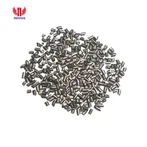
The diamond abrasive is evenly distributed on the working surface of the grinding wheel, showing the appearance of exposed protrusions, which has a strong cutting effect. When selecting abrasives, it is better to choose irregular crystal forms and rough surfaces, so as to improve the holding force of the bonding agent on diamond abrasives. In addition, the thickness of the diamond abrasive will directly affect the roughness of the polished workpiece surface and the grinding efficiency, and it is also related to the loss of the abrasive tool. In order to meet the requirements of processing workpieces, coarse-grained diamond abrasives should be used as much as possible, so as to improve grinding efficiency and reduce abrasive wear.

2. Binder design
The role of the vitrified bond is to bond the abrasive. The thermal stability of diamond abrasive is poor, and it will be oxidized when it is higher than 700°C in the air. In a protective atmosphere, after heating at 900°C, the compressive strength will also decrease significantly. Here, the firing temperature of the vitrified bond is proposed. Requirements - not too high. In addition, the expansion coefficient of the bonding agent should match the thermal expansion coefficient of the abrasive, so as to meet the working strength requirements of the grinding wheel, and the thermal conductivity of the bonding agent should not be too poor.
The bond must have a strong holding force on the diamond abrasive. Diamond has a strong ability to resist pressure and has a long service life. In order to give full play to the advantages of diamond abrasives and reduce processing costs, a reasonable bond formula design is critical.