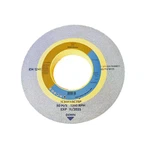
Do you know the influence of white corundum on the structural surface of grinding wheels? Today, I will briefly tell you about it.
While inspecting the hardness and cracking strength of the white corundum grinding wheel, the porosity and the inhomogeneity of the structure of the white corundum grinding wheel must also be inspected. Therefore, in order to obtain more complete abrasive tool characteristics and better determine the cutting ability of white corundum grinding wheels, it is possible to increase the pore volume size characteristics and inspection methods in the quality indicators of white corundum grinding wheels currently tested. The volume and size characteristics of the pores of the abrasive tool include several microstructure and quality indicators of the white corundum grinding wheel, such as the total volume of the pores, the size of the pores, the depth of the pores on the surface of the white corundum grinding wheel and the distribution of the pores in the white corundum grinding wheel. In order to test this new characteristic index, the corresponding testing instrument should be used.

The white corundum grinding wheel is a porous structure, because there is an air layer in the abrasive molding material injected into the model, like all loose crystals that are not firmly consolidated. This air layer is compressed during compaction as the molding material is compacted. At this time, a part of the air remains in the mold blank after demolding to form pores. Another part of the air overflows from the molding material and forms a channel or a stomata hole that communicates the pores with each other and with the outer surface, thus forming the initial stomata and stomata pore system.
The existence of the air hole system in the white corundum grinding wheel can be confirmed by the above air permeability inspection of the abrasive blank. At this time, it was found that the air permeability of the two ends of the abrasive tool was different when no supplementary pressure was performed, that is, the air permeability of the compacted side was relatively small, while the air permeability of the other side was relatively large. The molding compound is compacted so that more air emerges from the molding compound on this end face, thus reducing the number of air holes. When the abrasive molding material is not well stirred or the molding material is unevenly distributed in some parts of the model, the phenomenon of uneven concentration of abrasive particles and binders will occur. When compacting, this phenomenon will lead to different degrees of compaction in individual parts of the abrasive blank, different amounts of extruded air, and the formation of pores and pores of different sizes. This is the structure of the white corundum grinding wheel. inhomogeneity. This phenomenon can be explained from the different air permeability of various parts of the abrasive tool.
The various components of the binder, such as clay, talc, feldspar and water glass, etc., all have compounds that can be burned or evaporated at high temperature in their components, so the abrasive blank is sintered at a temperature of 1250~1300 degrees During the process, the burned and evaporated compounds form a gas in the green body. This gas tries to expand under the influence of high temperature, so it combines into a single space. Due to the inhalation of newly generated gas, these spaces continue to increase, which will sinter The binder is compacted to form pores. The gas space breaks through the binder at the thinnest part of the cross-section and combines with other gas spaces to form a channel, that is, a stomata orifice.