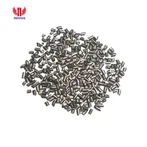
At present, most of the alumina ceramic tubes are made by the integral calcination process, which has many advantages compared with the traditional production process. In order to ensure the quality of the alumina ceramic tube, a hot pressing process is also added to the overall forging process. What are the measures for this treatment?

The overall fired alumina ceramic pipe is assembled by pouring the shaped ceramic pipe inside the steel pipe with special fillers. Since the alumina content of the ceramic pipe fittings lined with the alumina ceramic pipe is not less than 95%, plus the 200T dry Press forming, so the obtained alumina ceramic tube not only has smooth inner wall and good sealing performance, but also has very good wear resistance and corrosion resistance.
In the past, the production method of alumina ceramic pipes was to sinter ceramic powder into ceramic pipes according to molds, and then combine them with steel pipes. In this way, the products are easy to crack due to the rapid cooling of the furnace during the sintering process, and the process is more complicated.
In order to increase the plasticity of the alumina ceramic tube and meet the size and corrosion resistance in use, the hot pressing process is indispensable when the alumina ceramic tube is calcined as a whole. Before this, pre-pressing treatment is required to prevent defects such as core stacking and separation caused by the displacement of the alumina ceramic tube when it is loaded into the hot press. Pre-press at room temperature to bond into one monolithic material.
Then, the alumina ceramic tube is hot-pressed by the hot-bonding process. The hot-pressing temperature is about 140°C, the unit pressure is 2.5-3.0MPa, and the hot-pressing time is calculated according to the thickness of the finished alumina ceramic tube.Don't forget to use the three-stage depressurization treatment as a post-treatment process of hot pressing, in order to prevent the bubbling phenomenon of the alumina ceramic tube.
 |  |
After the hot-pressing treatment of the alumina ceramic tube in the above three aspects, it will meet the requirements of use to the greatest extent.