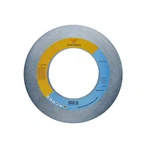
During the firing process, various mineral components in the vitrified grinding wheel binder interact with each other. Under the same firing temperature, atmosphere, and pressure conditions, only a small portion of some components may melt. The molten vitrified grinding wheel binder cools to form a glassy phase, which is uniformly distributed around the abrasive grains, binding them together. Vitrified grinding wheel binders with a refractoriness lower than the firing temperature become fused binders. Those with a refractoriness higher than the firing temperature become sintered binders; and those with a refractoriness close to or equal to the firing temperature become semi-sintered binders.
(1) Binders for corundum-based vitrified grinding wheel
Sintering binders are primarily used in corundum-based abrasives and come in many varieties. The most commonly used types are clay-feldspar (K2O·Al2O3·SiO2) and clay-feldspar-borosilicate glass (K2O·Al2O3·B2O3·SiO2).
The composition range for clay-feldspar binders is 20% to 50% clay and 50% to 80% feldspar. Binders with a clay content below 30% are considered fused binders, while those with higher clay content are considered sintered binders. The refractoriness of the binder increases with increasing clay content and decreases with increasing feldspar content. Clay-feldspar binders are inexpensive and meet the performance requirements of general-purpose corundum abrasives, but they cannot be used to manufacture coarse-grained and soft-grade abrasives.
The borosilicate glass in clay-feldspar-borosilicate glass binders has a refractoriness of 640-690°C and is a strong fluxing agent. Boron-containing binders are all fused binders; they have high fluidity, good high-temperature wettability, and strong reactivity, which helps to improve the strength of the abrasive. They are often used to improve the strength of abrasives and in coarse-grained and soft-grade abrasives with low binder content, high-speed grinding wheels, and superhard abrasives.
(2) Binders for silicon carbide-based vitrified grinding wheel
SiC abrasives commonly use sintered binders. At high temperatures, SiC decomposes into C and Si, and this decomposition intensifies with increasing liquid phase in the binder. When oxygen is insufficient, "black core" defects occur. The refractoriness of the sintered binder is higher than the firing temperature, and only a small amount of liquid phase is produced during sintering. The small amount of C from the decomposition of the abrasive grains is oxidized, and a thin film of SiC forms on the surface of the SiC abrasive grains, preventing further decomposition of SiC. Sintered binders have poor fluidity, reactivity, and high-temperature wettability. Abrasives made with these binders have low porosity, poor grinding efficiency, and are prone to burning the workpiece. They are mostly used for SiC abrasives with higher hardness.
Common binders used for SiC abrasives include clay-feldspar-quartz type, clay-feldspar-quartz-talc type, and clay-feldspar-borosilicate glass type. The raw material ratio range for clay-feldspar-quartz binders is 15%~30% quartz, 40%~65% feldspar, and 20%~35% clay. These are mostly sintered binders, which are relatively brittle, and the abrasives are suitable for grinding harder workpieces. Clay-feldspar-quartz-talc binders are also sintered binders, mainly used in the manufacture of SiC abrasives of medium hardness or higher. They have a high acid-base ratio, strong resistance to "black core" formation, and prevent the abrasive from turning red. Clay-feldspar-borosilicate glass binders have higher strength and are suitable for manufacturing high-speed SiC grinding wheels at 60 m/s. These binders are of the fused type, have a high acid-base ratio, and the products are less prone to "black core" defects.
(3) Binders for diamond and cubic boron nitride vitrified grinding wheel
Due to the poor thermal stability of diamond and cubic boron nitride, superhard abrasive tools must be manufactured using low-temperature firing with low-melting point binders. Low-temperature firing with low-melting point binders has the following characteristics:
① Low-temperature firing with low-melting point binders can save fuel costs and reduce the firing cycle.
② It can improve the quality of abrasive tools and reduce defective products. Low-temperature firing avoids the problem of poor high-temperature thermal stability of diamond and cubic boron nitride.
③ Low-melting point binders at room temperature include clay-feldspar-borosilicate glass-fluorite type, borosilicate glass-quartz-corundum powder-solid water glass type, clay-boron-containing needle glass, and clay-feldspar-window glass type.
Common glass binders used in diamond abrasives include SiO2·ZnO·B2O3 glass, Na2O·Al2O3·B2O3·SiO2 glass, and SiO2·Al2O3·TiO2·BaO·B2O3 glass. Cubic boron nitride abrasives commonly use SiO2·B2O3·Na2O·PbO·ZnO glass. Due to their low softening temperature, high strength, and good chemical stability, sodium borosilicate glasses are often chosen as the base glass for ceramic binders in diamond and cubic boron nitride abrasives. Other components are then added and adjusted based on the requirements of the binder, such as low melting point, low expansion, high strength, and good wettability. Currently, glass-ceramics are being used as glass binders in ceramic matrices for manufacturing diamond and cubic boron nitride abrasives. These glass-ceramics include silicate, aluminosilicate, fluorosilicate, and borate glass-ceramics. Fluorosilicate glass-ceramics are commonly used as binders; they are based on the MgO·Al2O3·SiO2 system, with the addition of strong fluxing agents such as fluorine and potassium to lower the melting temperature and crystallization temperature of the fluorosilicate glass-ceramic, thus achieving the low melting point required for superhard material binders.