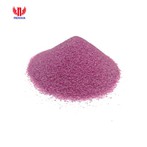
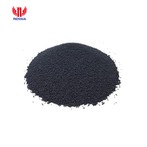
Tabular alumina offers several benefits that make it a valuable raw material for refractory products used in high-temperature environments. Its main advantages include high refractoriness, wear resistance, chemical stability, and thermal shock resistance.
1. High Refractoriness and Melting Point
Tabular alumina has a refractoriness of at least 1,800°C and a melting point of approximately 2,050°C. These properties help refractory products withstand extreme temperatures while maintaining structural stability and resisting erosion and cracking.
2. Excellent Wear Resistance
With a Mohs hardness of approximately 9.0, tabular alumina provides excellent resistance to abrasion and mechanical wear. It can withstand high-velocity material flow, mechanical impact, and particle abrasion, making it suitable for refractory linings exposed to harsh operating conditions.
3. Good Chemical Stability
Tabular alumina resists attack from many acidic and alkaline substances and offers good corrosion resistance. It also performs well in environments exposed to high-temperature gases, helping extend the service life of refractory linings.
4. High Thermal Shock Resistance
Its stable crystalline structure helps tabular alumina withstand rapid temperature changes. Refractory products and castables formulated with this material can achieve good thermal shock resistance and flexural strength after high-temperature treatment.
5. Low Thermal Conductivity and Good Insulation
Low thermal conductivity can reduce heat transfer through refractory structures, helping retain heat and improve thermal efficiency. This can reduce energy losses in industrial furnaces and other high-temperature equipment, depending on the overall refractory design.
6. High Strength and Hardness
Tabular alumina offers high mechanical strength and hardness, helping refractory products resist compression, external forces, and deformation. These properties contribute to dimensional stability and reliable long-term performance.
7. High Purity and Volume Stability
The production of tabular alumina does not require additives such as MgO or B₂O₃ as sintering aids. This helps maintain high purity and good volume stability. Its relatively low shrinkage during reheating also helps refractory products retain their dimensions at high temperatures.
8. Low Water Absorption
Its dense crystalline structure contributes to low water absorption, helping limit moisture uptake during storage and handling and supporting consistent material performance in refractory applications.
9. Wide Range of Applications
Tabular alumina is widely used as an aggregate in monolithic and shaped high-performance refractories. Typical applications include steelmaking, foundries, petrochemical processing, ceramics, and waste incineration.
It is also used in electrical insulators, kiln furniture, and catalyst carriers, where high-temperature stability, chemical resistance, and material purity are essential.