Garnet abrasive has a relatively high specific gravity and is commonly used for surface sandblasting. The sandblasting process produces less dust, ensuring operator visibility and health and safety.
Slag easily forms small particles and suspended solids, and quartz sand is a brittle abrasive; sandblasting can produce harmful substances that endanger health. Garnet sand, on the other hand, is a pure natural and environmentally friendly mineral that does not contain harmful substances such as free silicon and heavy metals. This product can be recycled, which greatly reduces the cost of use.
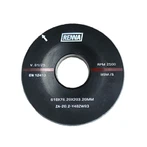
Garnet abrasive has a relatively high hardness, ranging from 7.5 to 8, making it a high-quality mineral that has seen widespread application in the abrasive industry in recent years. Especially in resin-bonded grinding wheels, which consist of abrasive grains, resin binder, and porosity, garnet abrasive can replace a small portion of brown fused alumina as a grinding wheel material, particularly for large slicing and angle grinding discs, without affecting performance.
Another method is to use finer particles as a pore filler. Using brown fused alumina as a pore filler results in a very hard grinding wheel and is also very expensive. Garnet abrasive is slightly softer than brown fused alumina and, being a natural abrasive, has a price advantage. Garnet abrasive commonly used as a filler in grinding wheels is usually black.