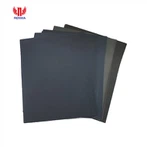
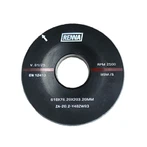
We analyze the impact on the performance of the grinding wheel from the following five characteristics of the resinoid grinding wheel:
(1) Abrasive material:
Commonly used abrasives for cutting grinding wheels include brown corundum (A), white corundum (wA), black corundum (BA), black silicon carbide (c), etc. The most commonly used abrasives are brown corundum because of its high hardness, toughness, and It has the characteristics of sharp particles, strong applicability and lower price than other abrasives. Brown corundum is divided into first-grade sand and second-grade sand according to whether it is fully restored during smelting, which is mainly reflected in the chemical composition: the Al2O3 content of the first-grade sand is ≥94.5; the Al2O3 content of the second-grade sand is <94.5%; generally 85% About 4%, and the Fe2O3 content is 4-5%; therefore, the hardness of the second-grade sand is lower than that of the first-grade sand, but the price is also lower; brown corundum is suitable for processing various carbon steels and general alloy steels; white corundum has higher hardness than brown corundum. It has high brittleness and low grinding heat. Because of its high price, it is used when the workpiece requires small thermal deformation. It is also used as a mixed abrasive for processing special materials. The Al2O3 content of black corundum is 70 to 85%, and the Fe2O3 content is 7 to 9%. , has low hardness and poor cutting force, but the price is also cheap; black silicon carbide has high hardness and good brittleness, sharp cutting edges, good self-sharpening performance, and good thermal conductivity. It has advantages in processing non-ferrous metals, plastics, rubber, and cast iron.

(2) Abrasive particle size:
Commonly used particle sizes are: 22#-80#. When the particle size is fine, the cutting efficiency is low.
(3) Grinding wheel hardness:
Commonly used hardnesses: P, Q, R; N, S; generally use harder grinding wheels to reduce grinding wheel wear. Its hardness is controlled by factors such as the amount of binder, molding density, firing temperature and firing time.
(4) Binder:
Commonly used resin binders include: powdered phenolic resin and liquid phenolic resin. Powdered phenolic resin has good craftsmanship, a slightly smaller molding density, a slightly larger texture number, and a higher price than liquid phenolic resin; liquid phenolic resin is cheap, but the material is easy to agglomerate and the mixture is not uniform, which can easily cause localization of the mold. hard.
(5) Organization:
The tissue number of the cutting grinding wheel should be slightly larger to improve cutting efficiency: if it is too large, it will affect the strength. Commonly used tissue numbers are No. 3 to No. 7.