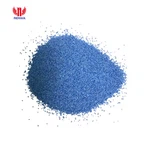
The chemical composition of abrasives plays a decisive role in the physical, chemical and mechanical properties of abrasives. Even if there is a slight change in chemical composition, it may cause a big difference in its properties. Therefore, there are many strict regulations on the chemical composition of various abrasives.
The chemical composition has a great influence on the properties of the abrasives. For silicon carbide, the higher the content of silicon carbide, the better the hardness and grinding performance will be. The crystal block of first grade silicon carbide usually contains about 98% SiC, and its impurities (mainly silicon dioxide, silicon, carbon, iron, aluminum, calcium, magnesium) account for about 2%.
The chemical composition of corundum also has a great impact on the properties of the abrasive. White fused alumina has a higher hardness than brown fused alumina due to its higher content of Al2O3. It is brittle and has good cutting performance. Besides, the black fused alumina has low hardness and good toughness due to the low content of Al2O3, so it is suitable for making coated abrasive tools.
The presence and content of other chemical components also have a great influence on the properties of corundum. For example, the increase of TiO2 content in brown fused alumina can increase the toughness of corundum, but the Na2O in white fused alumina will result in poor grinding performance and the hardness declining of β一Al2O3 generated. But white fused alumina can be made into pink fused alumina or fused zirconia alumina which can improve its performance such as toughness, if Cr2O3, ZrO2 and other chemical components are added into white fused alumina during the process of smelting.