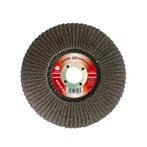
The abrasive belt production process has extremely strict requirements on the abrasive belt substrate, abrasive, binder and sand planting density. The premature end of the abrasive belt life is often caused by improper use. Here are a few typical examples. problem is analyzed.

Stick Cover
When a layer of metal material covers the abrasive cutting edge, the sticking occurs, and the surface of the abrasive belt becomes bright and shiny, and the hand feels slippery. The sticking mainly occurs in metal materials with high strength, especially in hard and tough materials.
Insufficient grinding pressure is the main cause of sticky caps. For materials with high hardness, insufficient pressure makes it difficult for abrasive particles to cut into the workpiece and to break and self-sharpen.
A softer contact wheel or platen, even with a high enough grinding pressure, will only collapse so badly that it is difficult for the abrasive particles to press into the workpiece.
The higher abrasive belt speed makes the time of the abrasive grains in the grinding area insufficient, the depth of the cut into the workpiece becomes thinner, and the heat is severe.
The causes of sticking caps are comprehensive, and the solutions are also comprehensive, that is to say, a suitable contact wheel or pressure plate, a sufficiently high grinding pressure, and a low abrasive belt speed are the fundamental solutions to the problem. Of course, it is also necessary to choose abrasives with good self-sharpening.
Blunt
In the grinding process, although all the abrasive grains are still present, the sharpness is already very poor. This is due to the dulling of the abrasive grain cutting edge due to wear, a phenomenon known as blunting. The normal blunting is the end of the life of the abrasive belt. Obviously, the "blunting" we refer to here is when the abrasive grains have not been used up, which is mainly caused by the selection or improper use of the abrasive belt.
A softer contact wheel or pressure plate makes it difficult for abrasive particles to cut into the workpiece, resulting in a flat edge.
Insufficient grinding pressure is also easy to dull the abrasive belt, and it is difficult for the abrasive to self-sharpen.
When the workpiece is hard, the selection of the abrasive belt is inappropriate, or the abrasive belt speed is high, and it is difficult to cut into the workpiece and become dull.
The abnormal wear of the abrasive belt seriously affects the service life of the abrasive belt and greatly increases the processing cost, so it cannot be ignored.

Blockage
Blockage is that the gap between the abrasive grains is quickly covered and filled with chips before the abrasive grain cutting edge is completely blunted, so that the abrasive belt loses its cutting ability.
There are many reasons for clogging, mostly due to improper use, material to be processed and selection of abrasive belts:
The contact wheel or pressure plate is too soft, making it difficult for abrasive grains to cut into the workpiece, and the abrasive belt is mainly in the grinding state. The solution should be to use a hard contact wheel and pressure plate, or a contact wheel and pressure plate with a peak tooth back, or a small diameter contact wheel and so on.
If the belt speed is too high, it is difficult for the abrasive particles to effectively cut into the workpiece, and blockage and workpiece burn will also occur. At this time, the belt speed should be reduced.
If the material to be processed is too soft (such as non-ferrous metals such as aluminum and copper), it is easy to cause the surface of the abrasive belt to be blocked. The solution should be: use a thinning abrasive belt; use a coarse-grained abrasive belt under the condition that the roughness requirements are met. Use the brittle silicon carbide abrasive belt; use the method of adding grinding aids, such as the use of lubricants.
The processing surface of the materials that are easy to block is smooth. For such materials, grease and coarse-grained abrasive belts that are easy to cause scratches should not be used. Ultra-coated abrasive belts should be used. This product has good chip removal and anti-clogging performance.