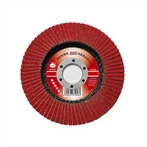
In the production of resin heavy duty grinding wheels, there are two distinct molding processes: cold pressing and hot pressing. These two processes are not simply technical choices but represent two technological paths developed to meet different operational requirements.
I. What Are Resin Heavy Duty Grinding Wheels?
Resin heavy duty grinding wheels are primarily used for billet and ingot grinding in the steel and foundry industries, withstanding extremely high radial pressures and impact loads. These wheels must possess extremely high strength, excellent heat resistance, and stable grinding performance to work safely and efficiently under pressures reaching thousands of Newtons.
It is precisely due to these demanding operating conditions that the production processes for resin heavy duty grinding wheels have developed into two technical routes: cold pressing and hot pressing.
II. Cold Pressing vs. Hot Pressing: The Essential Differences
1. Cold Pressing Process
The mixture is pressed into shape at room temperature, then sent to an oven for prolonged heating to cure.
Characteristics: Low equipment threshold, suitable for multi-variety small-batch production, but with a relatively loose microstructure.
2. Hot Pressing Process
Shaping and curing occur simultaneously at high temperatures of 150°C-200°C, with the resin flowing in a molten state and encapsulating the abrasives.
Characteristics: Requires specialized heated presses with higher investment, but results in extremely dense compacts, suitable for mass production.

III. Why Do These Two Processes Exist?
Reason One: Different Strength Requirements
For resin heavy duty grinding wheels, strength is the most critical indicator. The hot pressing process maximizes the elimination of pores, allowing the resin and abrasives to form a dense three-dimensional network structure, granting resin heavy duty grinding wheels extremely high impact resistance. Cold-pressed wheels have a relatively loose microstructure and struggle to achieve the strength levels required for heavy-duty conditions.
Reason Two: Utilization of Resin Fluidity
Phenolic resin only melts and flows at high temperatures. The hot pressing process leverages this characteristic, allowing the molten resin to uniformly penetrate the gaps between each abrasive grain, forming continuous bonding bridges. The cold pressing process cannot utilize this fluidity.
Reason Three: Production Efficiency Considerations
The hot pressing process has a short molding cycle, making it suitable for mass production of resin heavy duty grinding wheels. The cold pressing process requires prolonged baking, resulting in lower production efficiency, but offers greater flexibility for small-batch production.
IV. How to Choose the Right Resin Heavy Duty Grinding Wheel?
Choose Based on Operating Conditions:
For heavy-duty operations like billet and ingot grinding, priority should be given to resin heavy duty grinding wheels produced by the hot pressing process to ensure strength and safety.
Pay Attention to Brand Formulations:
Even with the same process, formula designs vary between different manufacturers. Choosing established brands is more reliable.
Consider Cost-Effectiveness:
Hot-pressed wheels have higher costs, but under heavy-duty conditions, they offer longer service life and lower safety risks, making them more economical in the long run.
V. Conclusion
The distinction between cold-pressed and hot-pressed resin heavy duty grinding wheels essentially represents technological paths developed to satisfy different operational demands. The hot pressing process, with its high strength and high density, has become the mainstream choice in the heavy-duty grinding field, while the cold pressing process maintains its advantages in specific applications.
Understanding the differences between these two processes helps users make more informed decisions when selecting resin heavy duty grinding wheels, ensuring safety and efficiency in grinding operations.