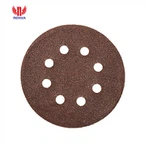
What is the backing base? The backing base is actually the carrier of the abrasive used in coated abrasive tools, and can also be called the foundation of coated abrasive tools.
Common types of coated abrasive backing include the following:
Paper Base:
The paper base used in coated abrasives is manufactured according to special manufacturing standards. Coated abrasives using paper as the backing are relatively flat and have unique adhesion, elasticity, weight, moisture absorption and waterproof capabilities. Suitable for applications with low pressure and need to adhere to the workpiece surface during application.
Characteristics of paper base:
|
Weight |
g |
Characteristic |
Application |
|
A |
Below 80 g/㎡ |
Yiquable |
Handwork |
|
B |
80-150 g/㎡ |
Yiquable |
Handwork |
|
C |
105-125 g/㎡ |
Yiquable/Strong |
Handwork/Eccentric machine |
|
D |
125-160 g/㎡ |
Yiquable/Strong |
Handwork/Eccentric machine |
|
E |
220-250 g/㎡ |
Sturdier |
Abrasive belt |
|
F |
250-320 g/㎡ |
Sturdier |
Wide and narrow abrasive belts |
Cloth base:
Cloth base is usually composed of cotton, polyester, polyester nylon, rayon, and blends of cotton and polyester. Among cloth bases, polyester nylon is stronger, straighter, and more expensive than polyester cloth. Polyester blended fabric is a blend of polyester fabric and cotton fabric, which has good strength, waterproofness and flexibility.
Cotton cloth is woven from natural fibers, but it is not waterproof. It has a lighter weight and good flexibility; - Man-made fibers are stronger than cotton and can be waterproof, and can be mixed with natural fibers and man-made fibers;
Polyester cloth is woven from fibers that are stronger than cotton and man-made fibers. It is waterproof, has good load-bearing capacity and anti-wear ability.
Features of cloth base:
|
Weight |
Strength |
Characteristic |
Application |
(Microscopic Bucket Chart) |
|
J cotton |
140 |
Light and flexible |
Suitable |
|
|
J polyester cloth |
170 |
Waterproof, strong, good flexibility |
Polishing |
|
|
X cotton |
210 |
good flexibility |
Post processing |
|
|
X polyester cloth |
300 |
Strong |
Moderate grinding |
|
|
Y polyester cloth |
350 |
Strong,not easy to wear |
High pressure |
|
|
H polyester cloth |
350 |
Strong,upright |
Broadband |
|
|
polyester nylon |
410 |
Sturdier |
Strong grinding |

Composite backing:
This backing is made of E paper base and cloth base bonded together. It has good load-bearing capacity and a flat bottom surface, and can have better ductility than paper base.
Fiber backing:
This backing is made of a mixture of hardened paper and cotton. It is usually used to make a sanding disc with a straight back base, and the thickness is usually 0.6mm, 0.8mm, 1.0 mm. Thicker fiber backings are used to make straight sanding discs, suitable for strong cutting, while thinner backings are used to make sanding discs with better elasticity.
Sieve-like back base:
Sieve-like back base is composed of many meshes. It is woven from polyester fiber and bonded with abrasive mineral sand. Its open mesh can effectively prevent grinding materials from clogging. Mesh specifications are usually 18x18 and 21x21.
Mylar Backing:
This backing is made of smooth polyester film coated with fine-grained abrasive mineral sand. This backing provides consistent machining accuracy and low roughness values.