
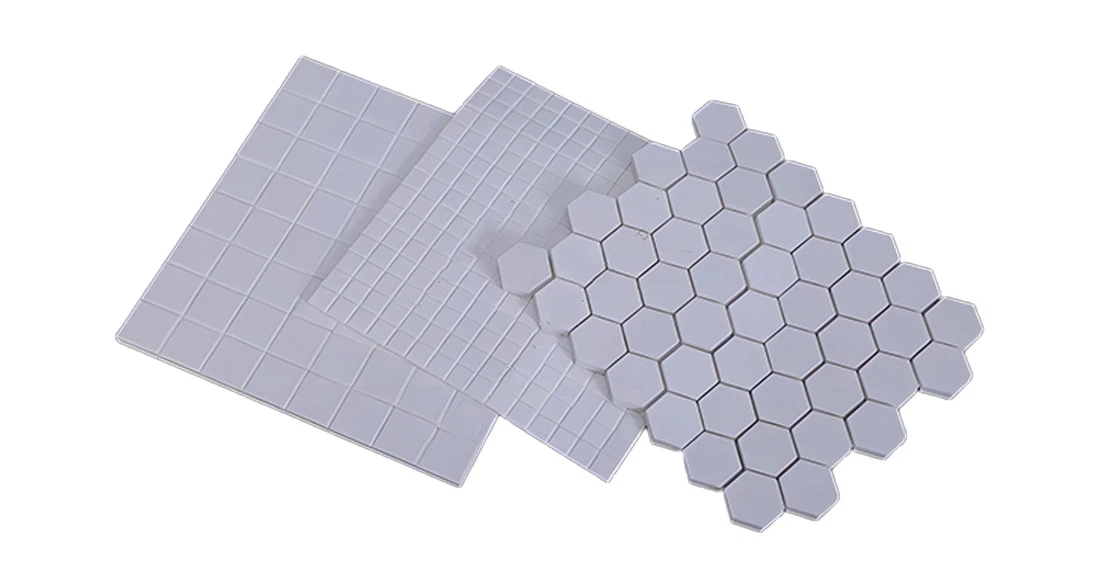
Alumina ceramic mosaic is a type of wear-resistant material that is widely used in various industries, especially in the grinding industry. Its high hardness, good wear resistance, and chemical stability make it an excellent material for grinding media and lining bricks.
In grinding applications, alumina ceramic mosaic is typically used as a lining material in ball mills, rod mills, and other similar equipment. Its primary function is to protect the equipment from wear and tear caused by the abrasive materials being ground. The ceramic material is also used as grinding media, which can effectively enhance the grinding efficiency and reduce the energy consumption of the process.
For grinding media, alumina ceramic mosaic has many advantages over other materials such as steel and zirconia.
Firstly, it has a higher density and hardness, which allows it to withstand the impact and wear of the grinding process better.
Secondly, the smooth surface of the ceramic material reduces the friction and improves the grinding efficiency.
Thirdly, the chemical stability of the material ensures that it does not contaminate the product being ground.
When used as a lining material, alumina ceramic mosaic has the advantage of protecting the equipment from wear and tear for a long time. The precision cutting and fitting of the mosaic tiles ensures that the lining has a high degree of flatness and evenness, which minimizes the impact of the grinding material and reduces noise. Furthermore, the ceramic material has a low coefficient of thermal expansion, which means that the lining remains stable even at high temperatures.
In addition to its use in the grinding industry, alumina ceramic mosaic is also used as a wear-resistant material in other industries such as steelmaking, mining, and chemical processing. Its high wear resistance and durability make it an ideal material for protecting equipment that is exposed to abrasive environments.


