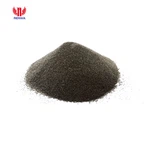
One of the important properties of an abrasive is its hardness, which must be harder than the material to be processed. The Mohs hardness tester is commonly used to determine the hardness of various abrasives. Another important property of abrasives is toughness or volume strength. The mixing amount, purity, particle size, and crystal structure of the raw materials can be changed to control this property to suit various applications.
For the manufacture of abrasive products, all raw materials need to be crushed and screened except for powdered talc and iron oxide. The screening particle size should be 4 to 900, that is, the diameter is about 6 mm (millimeter) to 6 μm (1 mm in millimeters). One) or finer. The grinding wheel is the most important abrasive product. It is mixed by abrasive and binder in a certain proportion, sintered by compression molding, and finally must be shaped, balanced and overspeed tested. Abrasive cloth and sandpaper are another kind of abrasive products with a large output. They are bonded to the base material (cloth or paper) by abrasive grains and dried to cut into different specifications. Others are powder or granular abrasives. After screening, they need to be processed by certain processes, such as grinding or polishing abrasives, usually with mineral grease or wax to meet the needs of different working conditions.