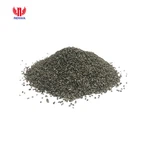
The main difference between bearing steel grit and ordinary steel grit is:
First, the difference of raw materials:
1. The raw materials of cast steel sand are generally scraps of high carbon steel or alloy steel;
2. The raw material of bearing steel sand is bearing steel. Bearing steel is high-purity iron-carbon alloy steel. Bearing steel is the steel used to make balls, rollers, and bearing rings. Bearing keys have high and uniform hardness and wear resistance, as well as high elastic limit. The requirements for the uniformity of the chemical composition of bearing steel, the content and distribution of non-metallic inclusions, and the distribution of carbides are all strict, and it is one of the strictest steel types in steel production. Therefore, his price is naturally much higher than that of ordinary scrap steel.

Second, the production process is different:
1. Cast steel sand follows the procedure of "sand making must first make pellets". It has to be smelted and has many casting defects. It is a product with high energy consumption and high pollution in the manufacturing process.
2. Bearing steel grit is directly quenched with forged bearing steel and then broken into steel grit. There is no smelting process in the manufacturing process, and there is no casting defect. It is an energy-saving product: and compared with cast steel grit, bearing steel grit can be cleaned In addition to the product, it can also be used as an abrasive for the manufacture of abrasive tools to polish and grind workpieces such as bearings.
Three, the difference of metal elements:
1. The metals contained in the steel sand are mainly carbon, manganese, silicon, sulfur and phosphorus;
2. Bearing steel grit contains precious metal-chromium element, which increases the fatigue life and wear resistance of the product itself.
Through the unique production process, the metallographic structure is excellent, the product particles are full, the hardness is uniform, the fatigue life is long, the impact resistance, the wear resistance is high, and the recycling rate can be effectively improved (the abrasive is gradually reduced during the blasting process), Thereby reducing the consumption rate of abrasives by more than 30%.

Fourth, the difference in appearance:
1.Cast steel sand is made of broken cast steel shot, so the surface of cast steel sand is often arc-shaped.
2.Bearing steel sand is directly quenched by bearing steel and then broken into sand, so there is no arc on its surface.
Whether it is cast steel sand or bearing steel sand, the higher the hardness, the faster the cleaning speed, the greater its consumption and the shorter the life span. Its manufacturing process determines its different sizes. The surface roughness is also higher, but the work efficiency is also high, and the wear is relatively large.
Although bearing steel grit has many remarkable points compared with cast steel grit, it also has a big disadvantage, that is, the price is high, so this means that although bearing steel grit is good, it is not as widely used as cast steel grit. s reason.