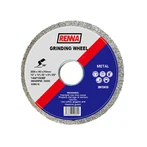
The deep grinding method for grinding discs differs from the transverse grinding method for grinding wheels. It primarily utilizes the entire grinding allowance (0.20-0.60mm) with a smaller longitudinal feed rate, removing it in a single longitudinal pass. With this grinding method, the disc must be trimmed to have a front cone or trapezoidal shape to gradually remove the allowance. Otherwise, the cutting work will be concentrated on the outer corners of the disc, causing them to quickly become blunt, affecting grinding efficiency and surface quality.
When dressing a stepped grinding disc, please note that the largest outer surface is used for fine grinding and finishing, so it should be dressed more finely. The remaining stepped surfaces are used for coarse grinding and should be dressed more coarsely. In addition, the step height close to the outer layer of the workpiece should be larger, while the step height close to the finished surface should be smaller. This is the only way to achieve high productivity while ensuring a low surface roughness value.
The transverse grinding method of the grinding disc is that the workpiece has no longitudinal movement, and the grinding wheel is continuously fed transversely to the workpiece at a very slow speed until all the grinding allowances are removed.
Compared with the longitudinal grinding method of the grinding disc, the characteristics of the transverse grinding method are:
1. The abrasive grains across the entire width of the grinding disc work uniformly, cutting new metal layers, fully utilizing the grinding wheel's cutting capacity and resulting in high grinding efficiency.
2. High heat generation and heat dissipation, combined with poor heat dissipation, can easily burn the workpiece when the grinding fluid supply is insufficient.
3. Because there is no axial relative movement, the abrasive grains leave repeated scratches on the workpiece surface. If the grinding wheel's shape is incorrect due to poor conditioning or uneven wear, this directly affects the workpiece's geometric accuracy. Therefore, transverse grinding generally results in lower precision and higher surface roughness than longitudinal grinding. To partially mitigate these drawbacks, manual feed can be used during the grinding process, especially during final grinding, to cause the workpiece to undergo a short longitudinal reciprocating motion.