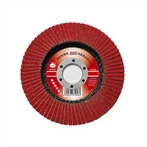
Black silicon carbide, as a high-performance inorganic non-metallic material, occupies an important position in the field of grinding wheel manufacturing due to its unique physicochemical properties.
It not only significantly improves the cutting performance, durability, and machining accuracy of grinding wheels, but also adapts to a variety of complex working conditions, making it an ideal choice for machining hard and brittle materials and high-efficiency grinding, providing core support for improving quality and efficiency in the machining industry.
I. Ultra-high hardness and wear resistance solidify the core cutting force of the grinding wheel
Black silicon carbide boasts a Mohs hardness of 9, second only to diamond and cubic boron nitride, far exceeding the hardness of ordinary abrasives. Its dense crystal structure, sharp abrasive grains, and excellent wear resistance make it ideal for machining high-hardness materials.
• When working with hard and brittle materials such as glass, ceramics, cemented carbide, and cast iron, it can easily penetrate the workpiece surface, preventing premature wear or chipping of the abrasive grains.
• Under the same working conditions, the service life of black silicon carbide grinding wheels is more than 30% longer than that of ordinary corundum grinding wheels, reducing wheel replacement frequency and improving machining continuity.
II. Excellent self-sharpening properties, maintaining the grinding wheel's continuous sharpness
Self-sharpening is a key characteristic of grinding wheels to maintain cutting efficiency, and black silicon carbide excels in this aspect. Under pressure during grinding, its abrasive grains uniformly break along crystal cleavage planes, forming new, sharp cutting edges.
• It maintains stable cutting performance without frequent wheel dressing, avoiding decreased machining efficiency and deterioration of workpiece surface quality due to abrasive grain dulling.
• It reduces time wasted on dressing and wheel material, lowering machining costs, making it particularly suitable for high-volume continuous production scenarios.
III. Excellent thermal conductivity and heat dissipation ensure machining accuracy
Black silicon carbide possesses excellent thermal conductivity, far superior to corundum-based abrasives. This property allows the grinding wheel to rapidly dissipate heat from the cutting zone during high-speed grinding.
• Effectively reduces workpiece thermal deformation and burning caused by high temperatures, protecting workpiece dimensional accuracy and surface finish.
• Prevents structural damage to the grinding wheel due to overheating, extending its lifespan while improving the safety and stability of the grinding process.
IV. Strong chemical stability, suitable for diverse processing scenarios
Black silicon carbide does not chemically react with most metals and non-metals at room temperature, exhibiting outstanding resistance to acids and alkalis and corrosion.
• It can be used to process special materials that are easily oxidized or react with other abrasives, such as titanium alloys and high-silicon aluminum alloys, avoiding chemical contamination of the workpiece surface.
• It can adapt to various machining methods, including dry grinding and wet grinding, maintaining stable performance under different cooling media and operating conditions, demonstrating strong versatility.
V. High cost-performance ratio, balancing performance and cost
Compared to superhard abrasives such as diamond and cubic boron nitride, black silicon carbide boasts a mature production process, readily available raw materials, and a more cost-effective approach.
• While meeting the processing needs of medium- to high-hardness materials, it significantly reduces grinding wheel manufacturing costs, providing companies with more flexibility to control production costs.
• Its performance is close to that of high-end abrasives, yet its price is more affordable, making it a cost-effective choice for small and medium-sized processing enterprises and general grinding applications.
Black silicon carbide, with its core advantages such as high hardness, good self-sharpening properties, excellent thermal conductivity, chemical stability, and high cost-effectiveness, has become the preferred material for grinding wheel manufacturing. It not only drives the upgrading of grinding wheel products towards "high efficiency, precision, and durability," but also helps the machining industry achieve quality and efficiency improvements in scenarios such as hard and brittle material processing and mass production.